The Cottagegoth Kitchen:
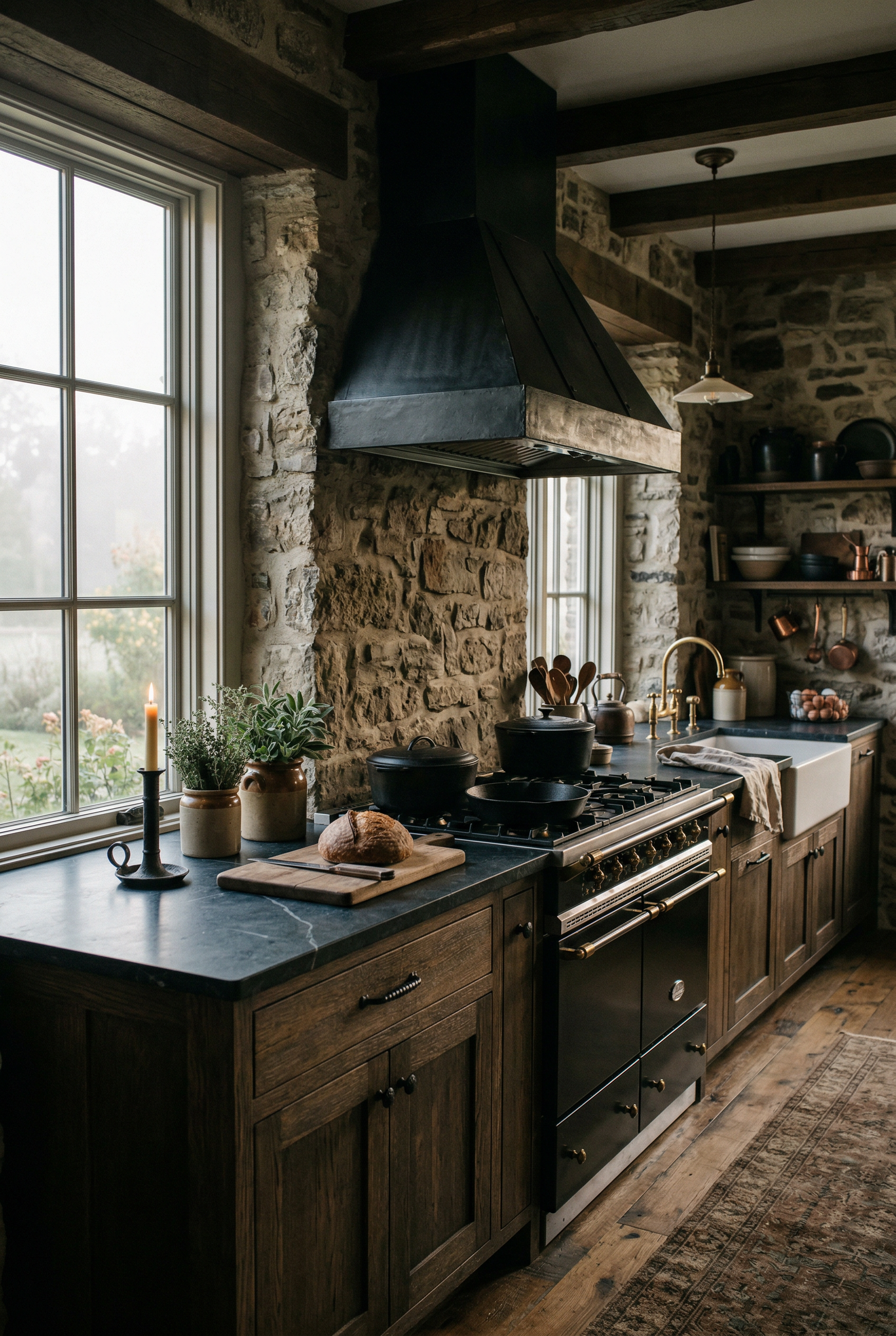
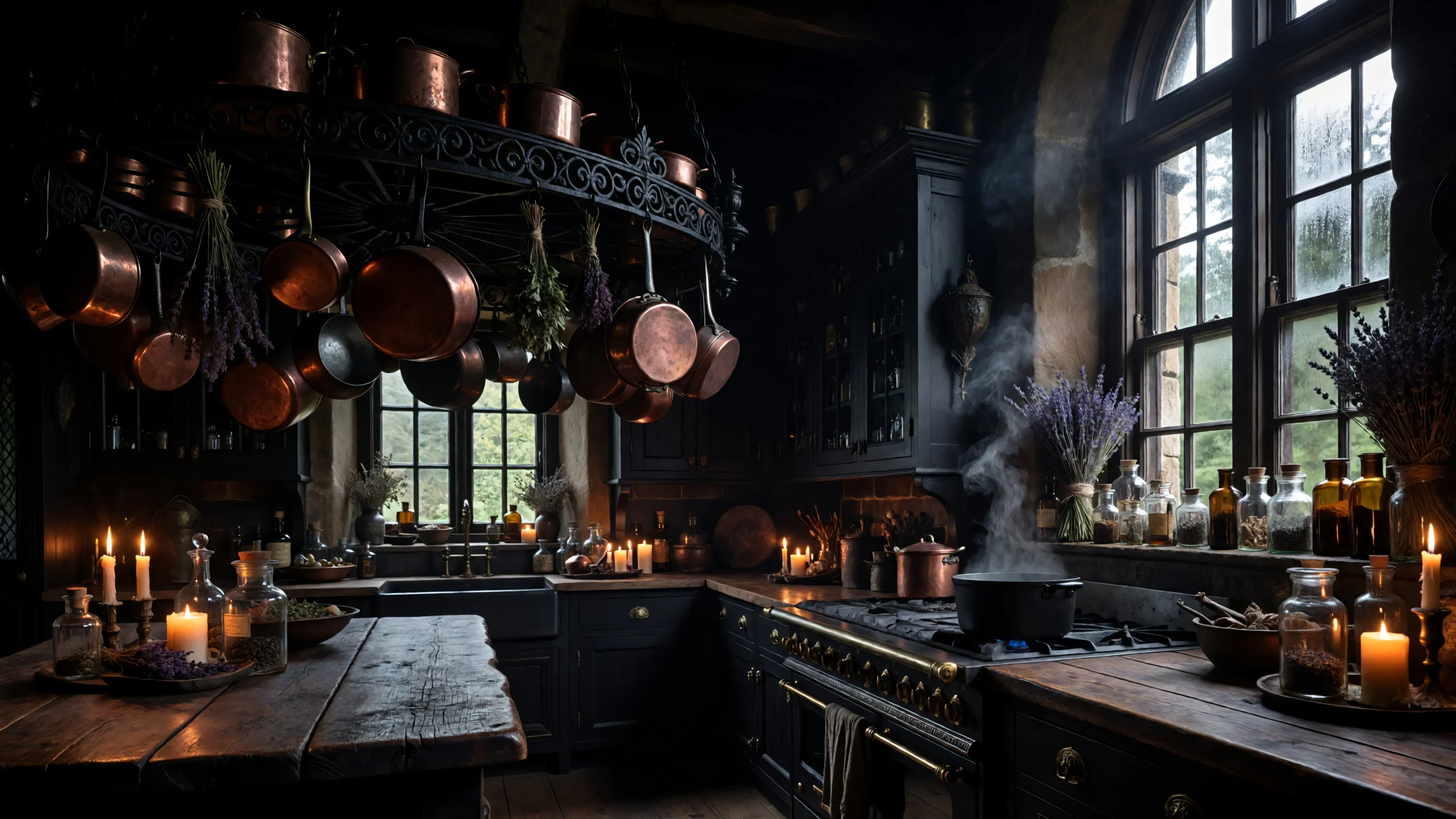
There is a kind of kitchen that exists in the space between old stories and lived-in warmth. It smells of woodsmoke and dried rosemary. The cabinets are dark — charcoal, or forest green, or the deep blue-black of a cloudy autumn sky — and the hardware is brass, worn soft where hands have touched it ten thousand times. Apothecary jars crowd the window ledge. A cast iron skillet hangs from an iron hook, heavy with history. The light here is never harsh. It comes from beeswax candles, from the glow of a range hood, from the grey morning pressing through glass thick with moisture.
This is the cottagegoth kitchen. And it is having a moment.
Pinterest’s Spring 2026 Trend Report clocked a +915% surge in searches for “dark cottagecore kitchen.” Not minimalist dark. Not industrial dark. Something warmer, stranger, more alive — a kitchen that feels like it belongs to someone who knows how to make something from nothing, who keeps dried herbs because they actually use them, who prefers candlelight not as an aesthetic choice but as a way of being.
If you’ve been staring at your white kitchen for five years and feeling like something is missing, it might be this.
Why the White Kitchen’s Era Is Over
For more than a decade, the reigning vision of the aspirational kitchen was white. White cabinets, white subway tile, white marble countertops, stainless steel appliances. Bright. Sterile. Easy to photograph. Easy to sell.
And then, slowly, something shifted.
The women leading the conversation on Pinterest, on cottagecore blogs, in dark academia corners of the internet, started gravitating toward something different. Kitchens that felt inhabited. Kitchens that smelled like something. Spaces that acknowledged the kitchen for what it has always been — not a showroom, but the heart of a house. A place of transformation, where raw things become nourishing ones.
Dark cottagecore — and its slightly more dramatic cousin, cottagegoth — reclaims that original purpose. The moody palette isn’t trying to shock. It’s trying to root. To ground. To say: this kitchen has a history, and you are part of it now.
The aesthetic caught first among women who had grown tired of aspirational spaces that never seemed to belong to anyone. Moody farmhouse kitchen cabinets. Gothic cottage kitchen ideas. Dark farmhouse kitchen aesthetic. Each search tells the same story: someone looking for a home that feels like theirs.
What Exactly Is a Cottagegoth Kitchen?
Cottagegoth sits in the overlap between cottagecore — pastoral, handmade, soft around the edges — and dark aesthetics that carry a folkloric, slightly witchy undertone. It is not gothic in the maximalist, dramatic sense. It is grounded. Functional. The aesthetic does not perform; it simply is.
Think of it this way: if cottagecore is a sun-drenched afternoon picnic in a meadow, cottagegoth is the kitchen of the wise woman who lives at the edge of that meadow. She has herbs drying on every hook. Her cast iron is seasoned with decades of use. There are candles, yes, but there’s also a pot of something simmering low on the range. The darkness here is not decoration. It is depth.
The core aesthetic markers:
- Deep cabinet colors: charcoal, forest green, slate, navy, near-black
- Aged brass or blackened iron hardware — nothing polished, nothing bright
- Open shelving with functional objects on display: jars, crocks, ceramics
- Apothecary bottles and jars filled with dried herbs, spices, and salts
- Dried herb bundles hanging from hooks, rafters, or cabinet pulls
- Cast iron cookware used daily and displayed with intention
- Dark tile: matte charcoal subway tile, deep zellige, slate
- Natural wood accents: butcher block, dark-stained open shelves
- Warm, low light: amber pendants, beeswax candles, never overhead fluorescent
The Six Essential Elements of a Cottagegoth Kitchen
You do not need to gut your kitchen to begin. The cottagegoth aesthetic is built in layers — some foundational (cabinet paint, hardware), some entirely accessible on a weekend afternoon with a trip to the hardware store and a bundle of dried lavender.
1. Dark Cabinets — The Foundation of Everything
The single biggest visual transformation in any kitchen is the cabinet color. Charcoal is the entry point — versatile, warm in the right light, compatible with everything. Forest green reads more rustic and alive. Deep navy has a slightly more refined farmhouse-library quality. Near-black is the most committed choice. All of them work.
Cabinet paint — even for renters who own their own cabinets — is one of the highest-impact, most budget-accessible moves available to you.
2. Aged Brass or Blackened Iron Hardware
Nothing dates a kitchen faster than generic silver hardware. A swap to aged brass — warm, folkloric, softening beautifully over years of use — or blackened iron, which reads more dramatically, transforms the entire feel of the space. You can do an entire small kitchen for under $80 on a Saturday afternoon with a screwdriver.
3. Apothecary Jars and Open Shelving
The cottagegoth kitchen does not hide its ingredients behind closed cabinet doors. Glass apothecary jars — cork-topped, glass-stoppered, wide-mouthed — filled with dried herbs, sea salt, whole peppercorns, loose tea, and spices are the visual signature of this aesthetic. Crowded on a window ledge or arranged on open shelving in descending heights, they suggest a kitchen that is used, that knows things, that has been tended.
4. Cast Iron — Displayed and Used
A well-seasoned cast iron skillet is the working symbol of the cottagegoth kitchen. It belongs on the stovetop, on a hook where it can be seen and reached without ceremony. A matte black Dutch oven, a small griddle — these are functional objects that also happen to be the most beautiful things in the room.
5. Dried Herb Bundles
Hung from a hook on a rafter, tied loosely to a cabinet pull, or arranged in a dark ceramic vase — dried herb bundles add texture, quiet scent, and the unmistakable sense that this kitchen produces something. Lavender, rosemary, sage, thyme, bay laurel. Bundle them yourself from the garden or buy from an herbalist. They last for months and cost almost nothing.
6. Warm, Low Light
Overhead fluorescent lighting is the single greatest enemy of the cottagegoth kitchen. Supplement or replace with amber-bulb pendant lights over the island or sink, a small counter lamp, beeswax tapers in iron holders, or battery-powered LED candles where open flame isn’t practical. The 2200K amber bulb — one change, $10 — transforms the entire emotional register of a room.
How to Build the Cottagegoth Kitchen at Every Budget
Under $100 — The Weekend Refresh
A set of aged brass cabinet knobs and pulls ($20–50 for a small kitchen). Three large glass apothecary jars filled with your most-used herbs and spices ($15–25). A bundle of dried lavender hung from a cabinet knob ($5–15, or free from your garden). Beeswax taper candles in a simple iron holder ($10–20). A 4-pack of amber LED bulbs to replace your harshest overhead ($8–12).
Total spend: under $100. Visual impact: transformative.
$100–$500 — The Real Shift
Add cabinet paint in charcoal or forest green (a gallon runs $40–70; most small kitchens need 1–2 gallons). New hardware throughout. A floating shelf in dark-stained wood for open display. A small cast iron Dutch oven in matte black enamel. A set of matching ceramic canisters in deep earth tones.
$500 and Beyond — The Full Transformation
A professional cabinet repaint. A dark tile backsplash. Under-cabinet amber lighting. Full open shelving with curated ceramics and jars. A vintage-style faucet in matte black or aged brass. A complete cast iron collection. This is the version that earns its own Pinterest board.
The bones of the cottagegoth kitchen do not require a renovation budget. They require intention.
Affiliate Picks: Shop the Cottagegoth Kitchen
This post contains affiliate links. If you purchase something through these links, I may earn a small commission at no additional cost to you. I only recommend products I’d actually put in my own kitchen.
1. Le Creuset Enameled Cast Iron Dutch Oven — Matte Black
The quintessential cottagegoth kitchen investment. Heavy, beautiful, nearly indestructible. It goes from stovetop to oven to table and looks extraordinary at every stage. The matte black finish is exactly right — functional and deliberate rather than decorative. Built to outlast you.
2. Aged Brass Cabinet Pulls — Antique Finish, Set of 10
The fastest single upgrade in any dark kitchen. Look for a warm, slightly worn finish — not polished, not bright. The older-looking, the better. A set of 10 typically runs $25–45 and takes an afternoon to install. The before and after is remarkable.
3. Glass Apothecary Jars with Cork Stoppers — Set of 6
Clear glass with natural cork tops. Fill them with dried herbs, sea salt, peppercorns, loose tea, or whatever you actually use. A set of six for $20–35 is the easiest entry point into the aesthetic and one of the most versatile.
4. Beeswax Taper Candles — Natural Ivory or Matte Black, Set of 12
Beeswax candles burn cleaner than paraffin, carry a faint honey-warmth scent, and their amber flame is exactly the quality of light this aesthetic calls for. Natural ivory or matte black — both are correct choices depending on your cabinet color.
5. Dried French Lavender Bundles — Set of 3–6 Stems
Hung from a hook above the sink or tied to a cabinet pull, dried lavender is one of the simplest and most evocative moves in the cottagegoth kitchen. It costs almost nothing, lasts for months, and scents the room softly without overwhelming.
6. Amber Edison LED Bulbs — 2200K Warm White, Dimmable, 4-Pack
Swapping your existing bulbs for 2200K amber Edison-style LEDs costs $10–20 and immediately shifts the entire emotional character of a kitchen. Dimmable versions give you full atmosphere control from bright-enough-to-cook to candlelight-adjacent. Start here if you start nowhere else.
The Cottagegoth Kitchen Is Not a Trend — It’s a Return
The dark, folkloric kitchen has existed for as long as kitchens have. Long before white subway tile became the dominant language of domestic aspiration, kitchens were dim and warm and layered with the evidence of use. They smelled of something. They carried their own histories.
We are not inventing anything here. We are remembering something that got painted over.
The cottagegoth kitchen says: this space is mine. It carries the smell of herbs I dry and use, the weight of a pan I’ve cooked in a thousand times, the warmth of a candle lit not for a photograph but because it makes the room feel like the kind of place where real life happens. Where things are made. Where people linger longer than they planned to.
That is not a trend. That is a homecoming.
Save this to your dark cottagecore Pinterest boards and start gathering your cottagegoth kitchen inspiration. Explore more dark farmhouse interior ideas here on the blog — and if you’re building out a moody kitchen of your own, I want to hear about it in the comments.
→ Browse more dark home aesthetic posts
→ Shop all cottagegoth kitchen picks