Affiliate disclosure: This post contains affiliate links. We may earn a commission through these links.
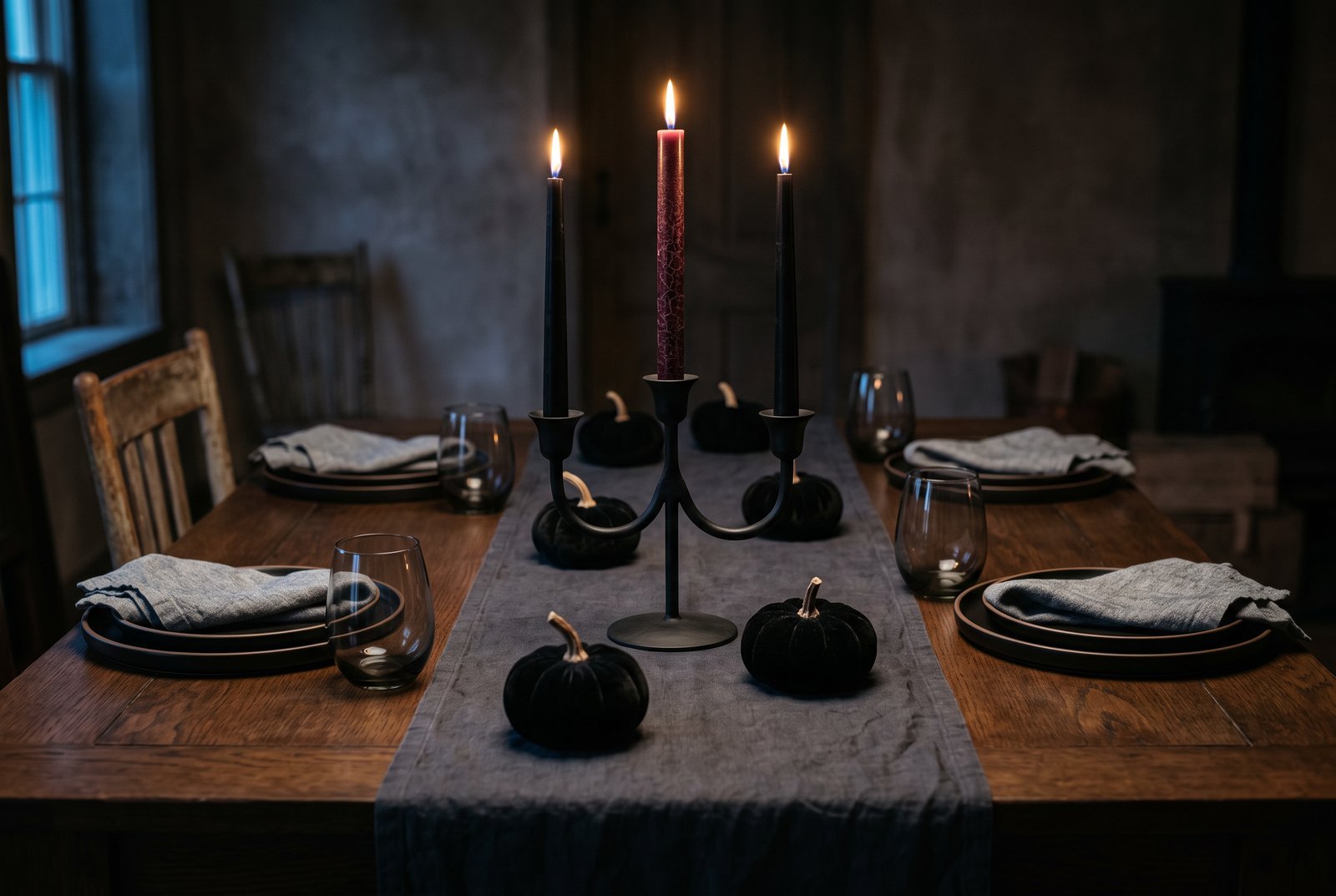
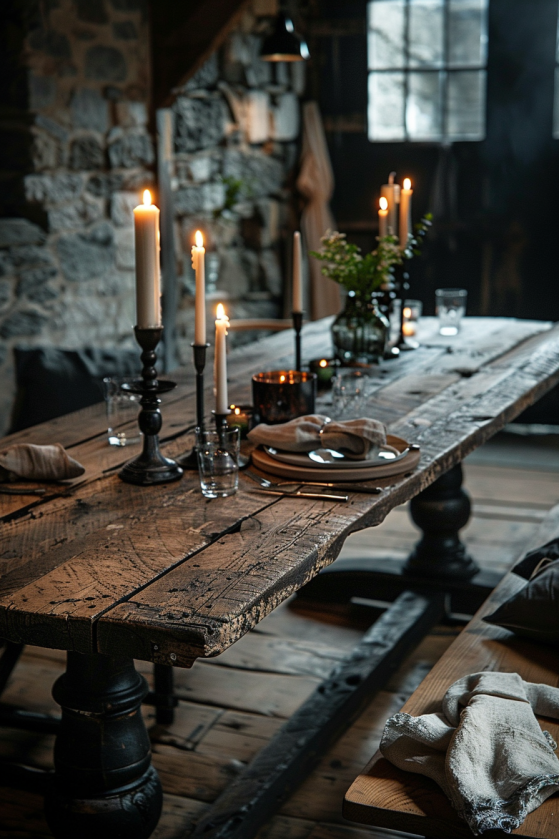
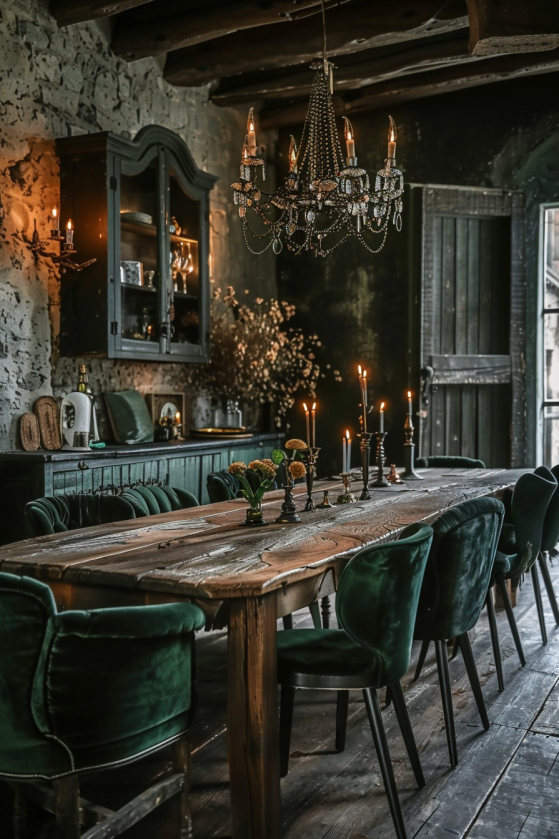
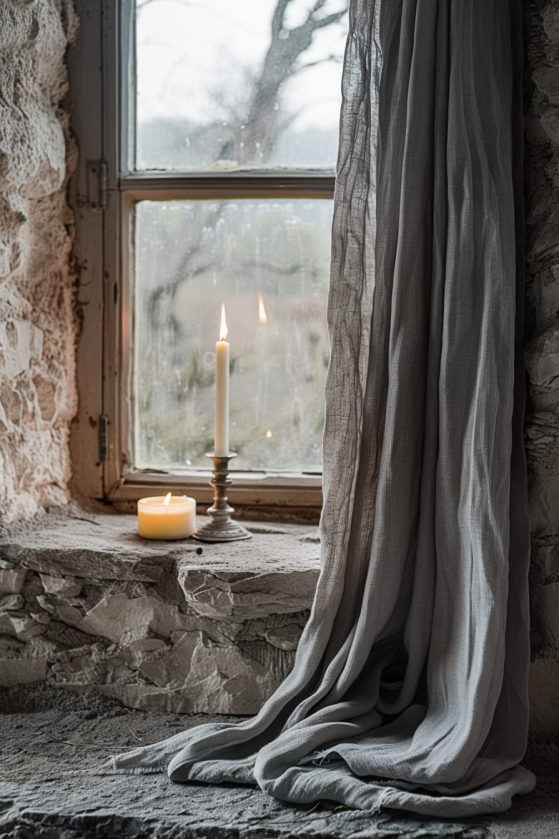
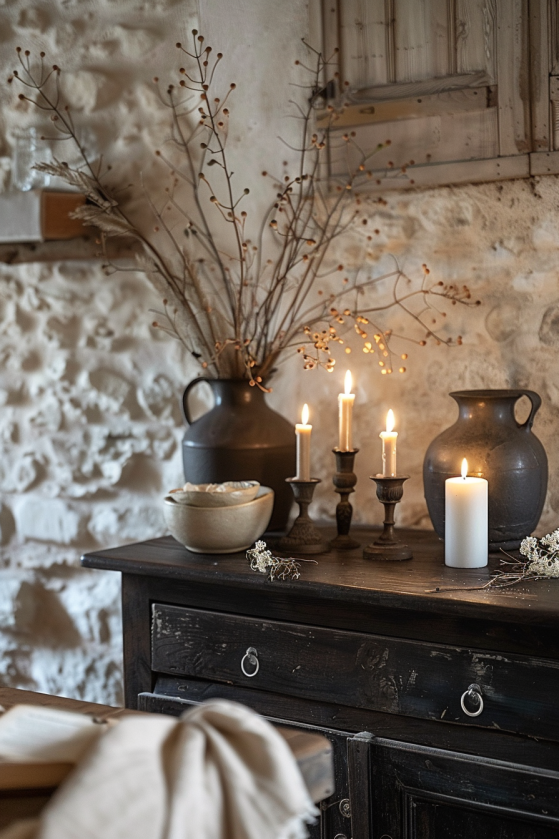
A moody thanksgiving table does not need a formal dining room or a dozen matching pieces. It needs candlelight, dark linen, and a few real finds you can actually buy. This friendsgiving table setup is built around a charcoal runner, black stoneware, smoked glass, and a small iron candelabra — a dark moody thanksgiving look that still feels like a farmhouse supper.
The pictures are AI styling illustrations — similar to the shoppable pieces, not photographs of them, and not a promise that a finished table will match the render. Recheck stock and shipping before you buy.
Start with dark linen and one farmhouse table centerpiece
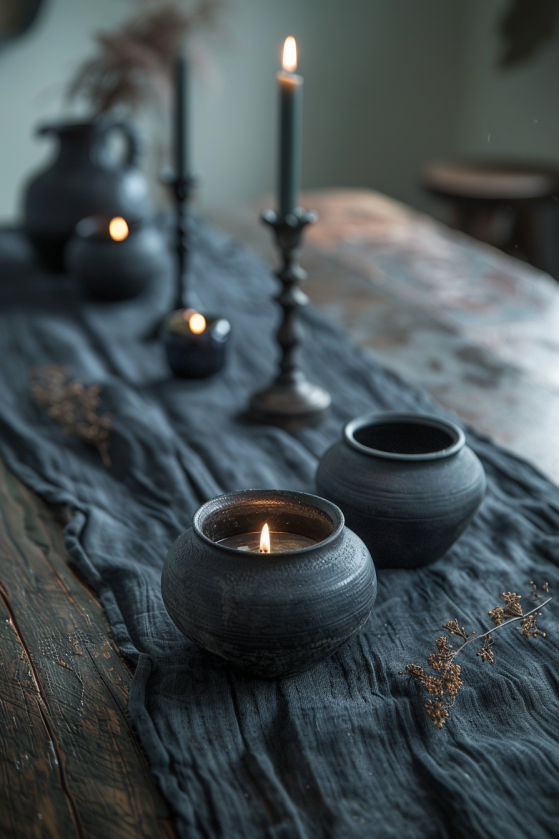
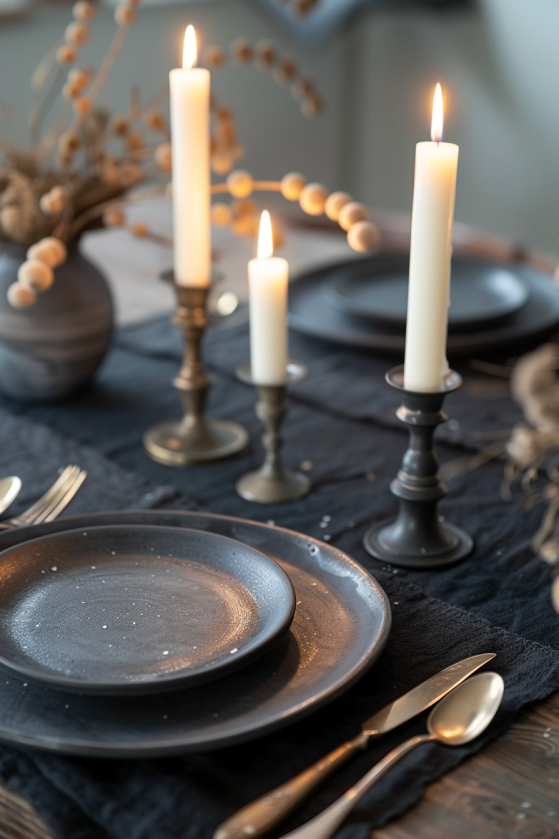
Lay a deep charcoal flax linen runner down the length of a wood farmhouse table and let it drape a little at the ends. That single strip of slate linen is the backbone of the look: everything else sits on it or beside it. The Quince 100% European Flax Linen Table Runner in Charcoal is the one in this setup.
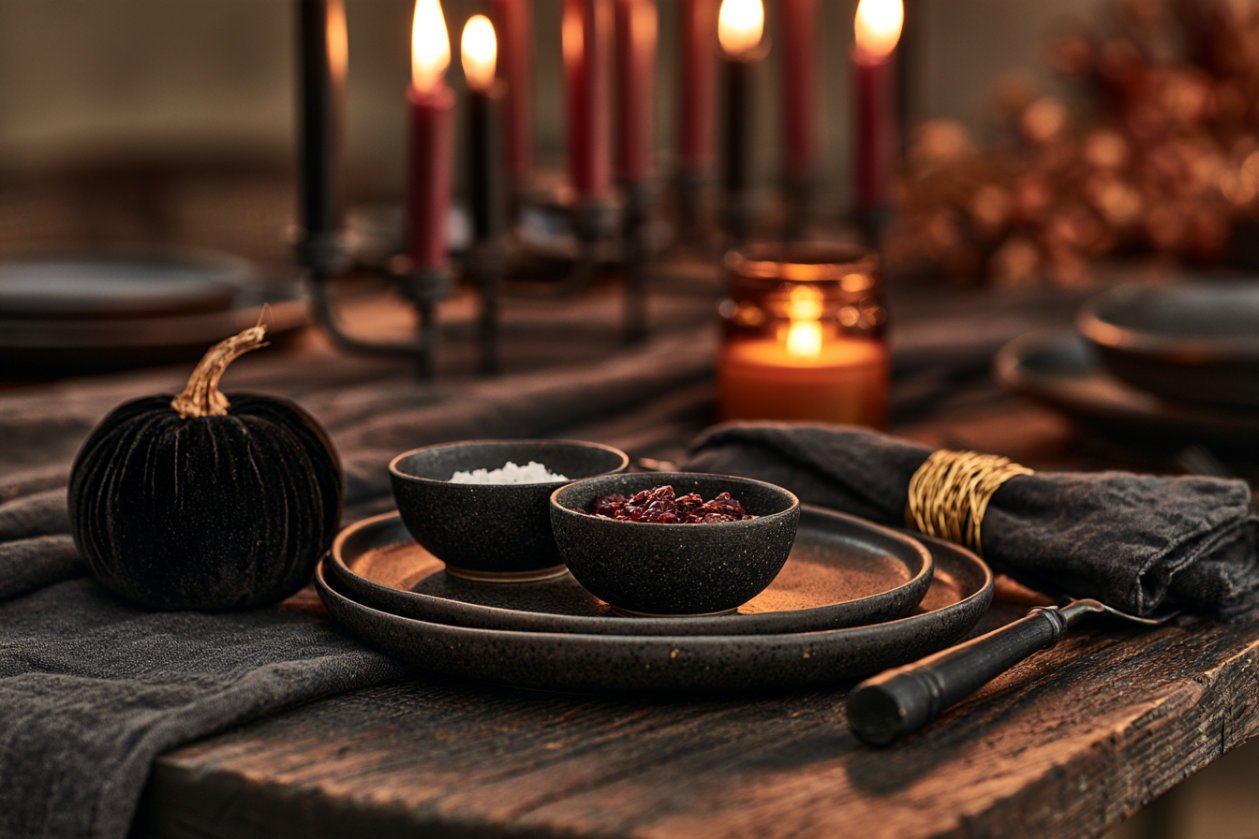
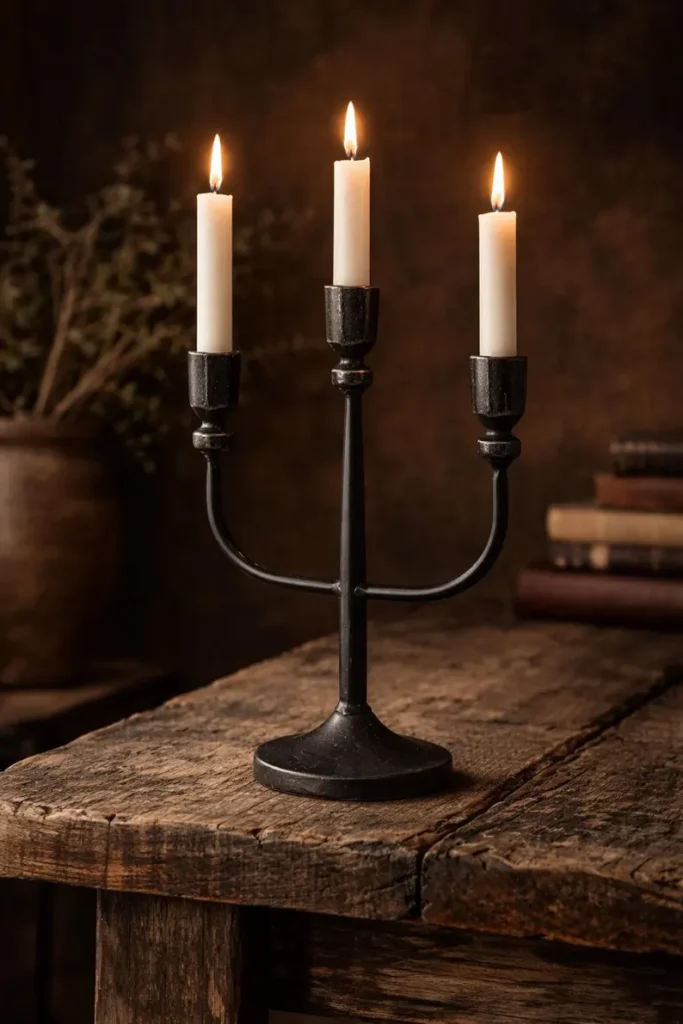
For the farmhouse table centerpiece, keep the middle of the table simple. A matte black hand-forged iron three-arm taper holder from World Market, two slim black hand-dipped tapers on the outer arms, and one crackled claret rustic taper in the center is enough. Scatter a few 4-inch handmade black velvet pumpkins with real stems from ThePermanentGarden along the runner so the candlelight has something soft to fall on. They are sold individually in 4-, 6-, 8-, and 10-inch sizes with natural dried stems; the small ones keep the center of the table from feeling crowded. Skip chargers and extra candlesticks — the table already has enough dark metal and glow.
Set each place with black stoneware, grey linen, and smoke glass
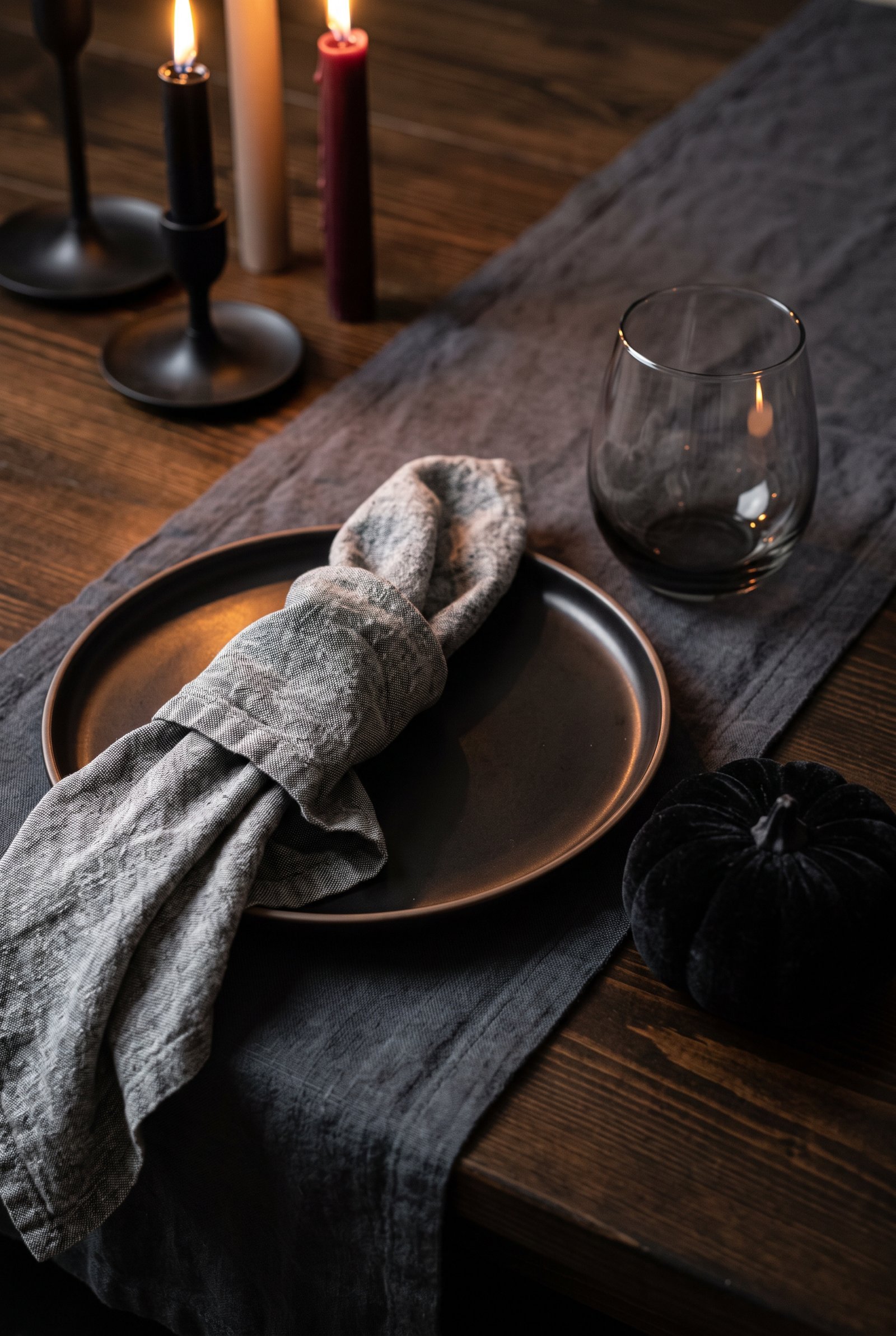
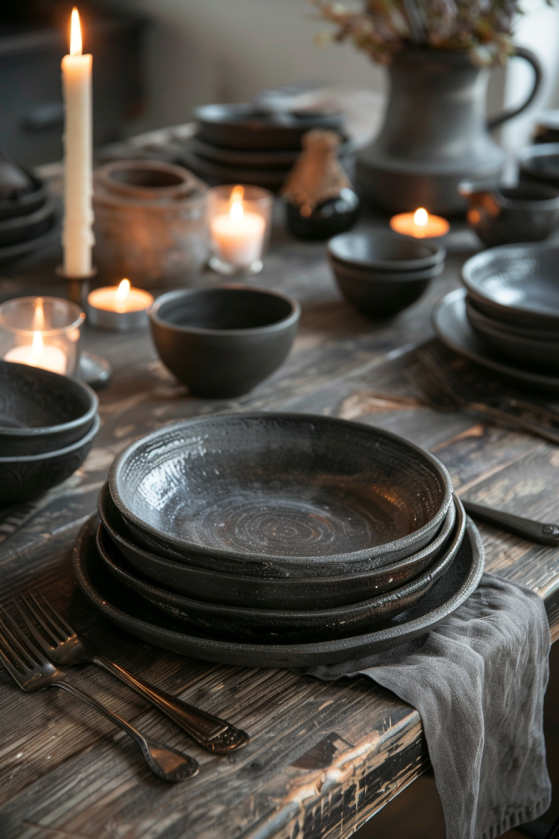
Each place setting should feel handmade and quiet, not formal. Start with a dark espresso-black stoneware dinner plate. On a tighter budget, the 10 Strawberry Street matte black plates come as a case of six and look clean and restaurant-modern. For a splurge, East Fork’s Black Mountain plates, sold as a set of four at Quince, are the closest to a studio-made black glaze.
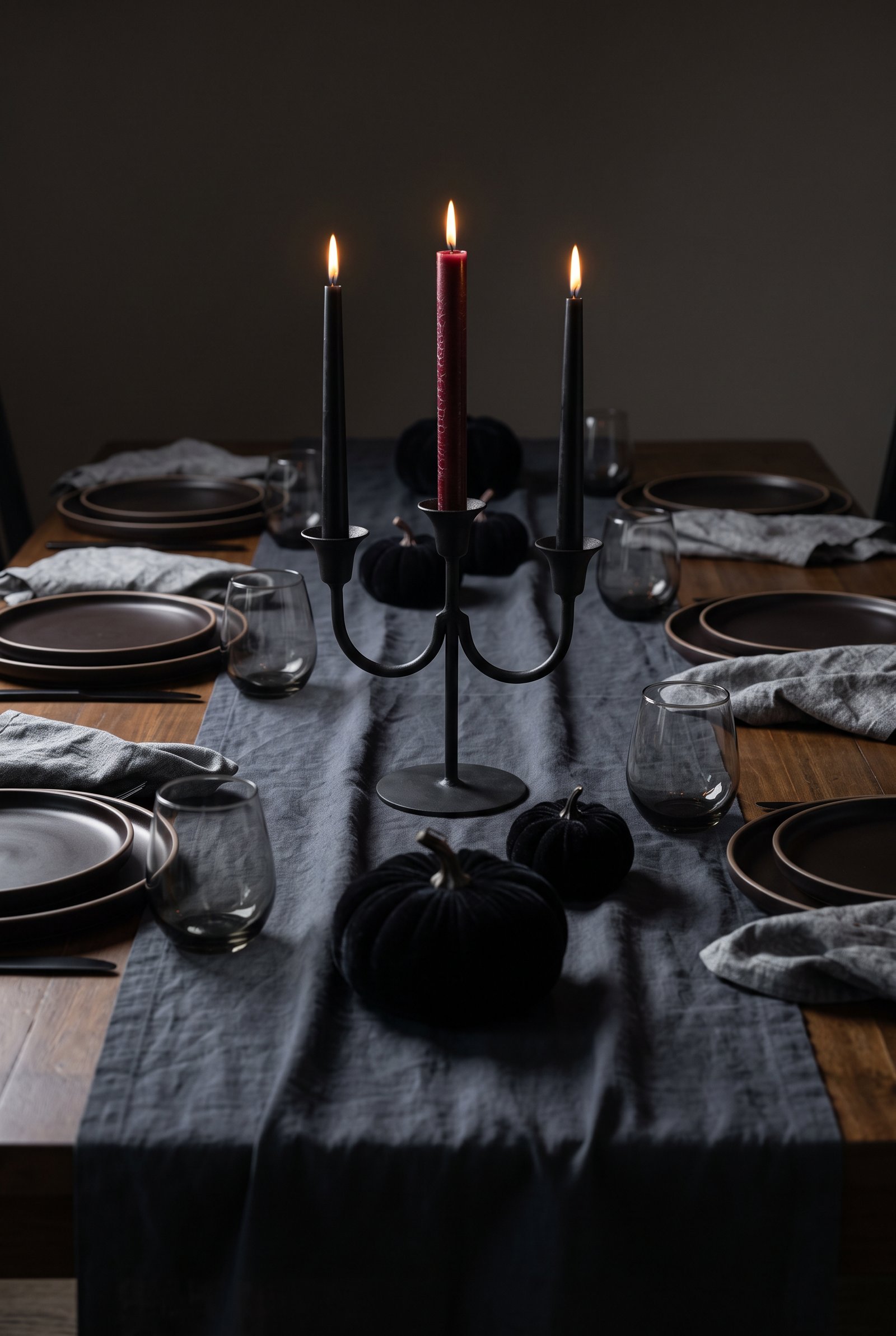
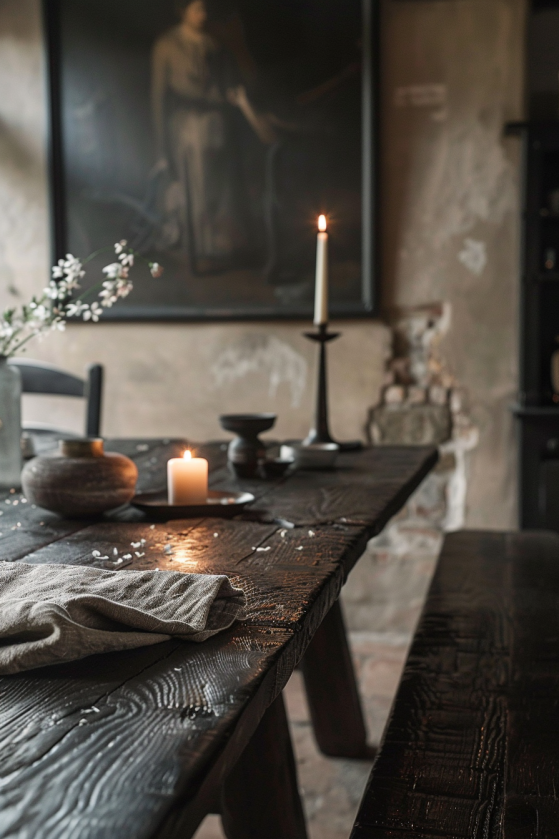
The view down the table is the one to save: a long charcoal runner, one iron candelabra, and those little black pumpkins coming toward you in the dark. If you are building out the rest of the room around this table, see our guide to creating a dark farmhouse dining room.
Little Finds for a Dark Harvest Table
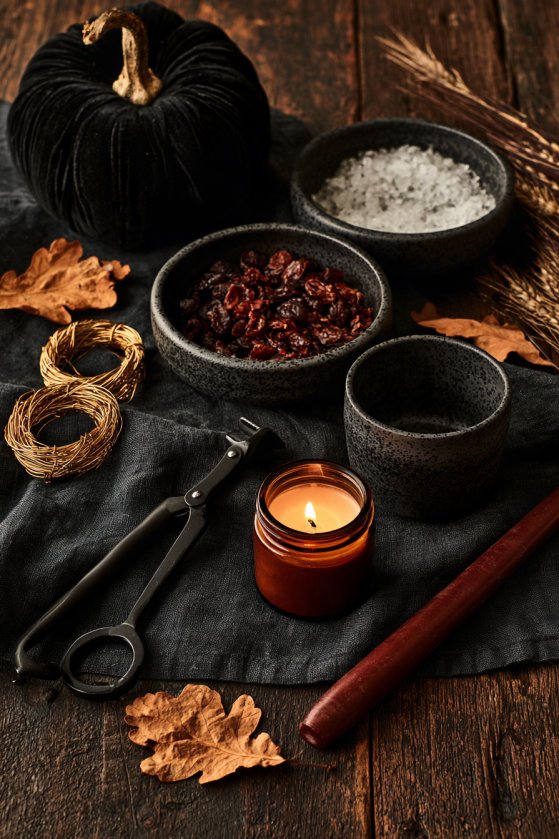
Once the runner and candelabra are in place, these are the small accents that finish the table. A black velvet pumpkin with a real dried stem, tiny speckled bowls for salt and cranberries, a gold wire napkin ring, and a little amber jar candle — all of it sitting on charcoal linen in the same dark harvest mix of black, claret, and warm brass.
Scatter them down the runner or keep them close to the plates, so the candlelight has something soft and small to fall on. A black wick trimmer and snuffer stay within reach of the tapers.
Affiliate disclosure: This post contains affiliate links. We may earn a commission through these links.
Six sourced dark-cottage reading corners, each built around a real chair, table, pillow, lamp, framed picture, and a paint sample you can try on the wall. The pictures are AI styling illustrations — similar to the shoppable pieces, not photographs of them, and not a promise that a finished room will match the render.
Paint prices below are for a sample only, not a room quantity. Merchandise totals are the listed pieces before tax, shipping, and paint, checked on November 10, 2026. Recheck sizes, stock, and prices before you buy. For a full nook plan that covers seating, paint, and shelving, see our guide to styling a gothic reading nook.
Look 1 — Olive Pewter Green farmhouse nook
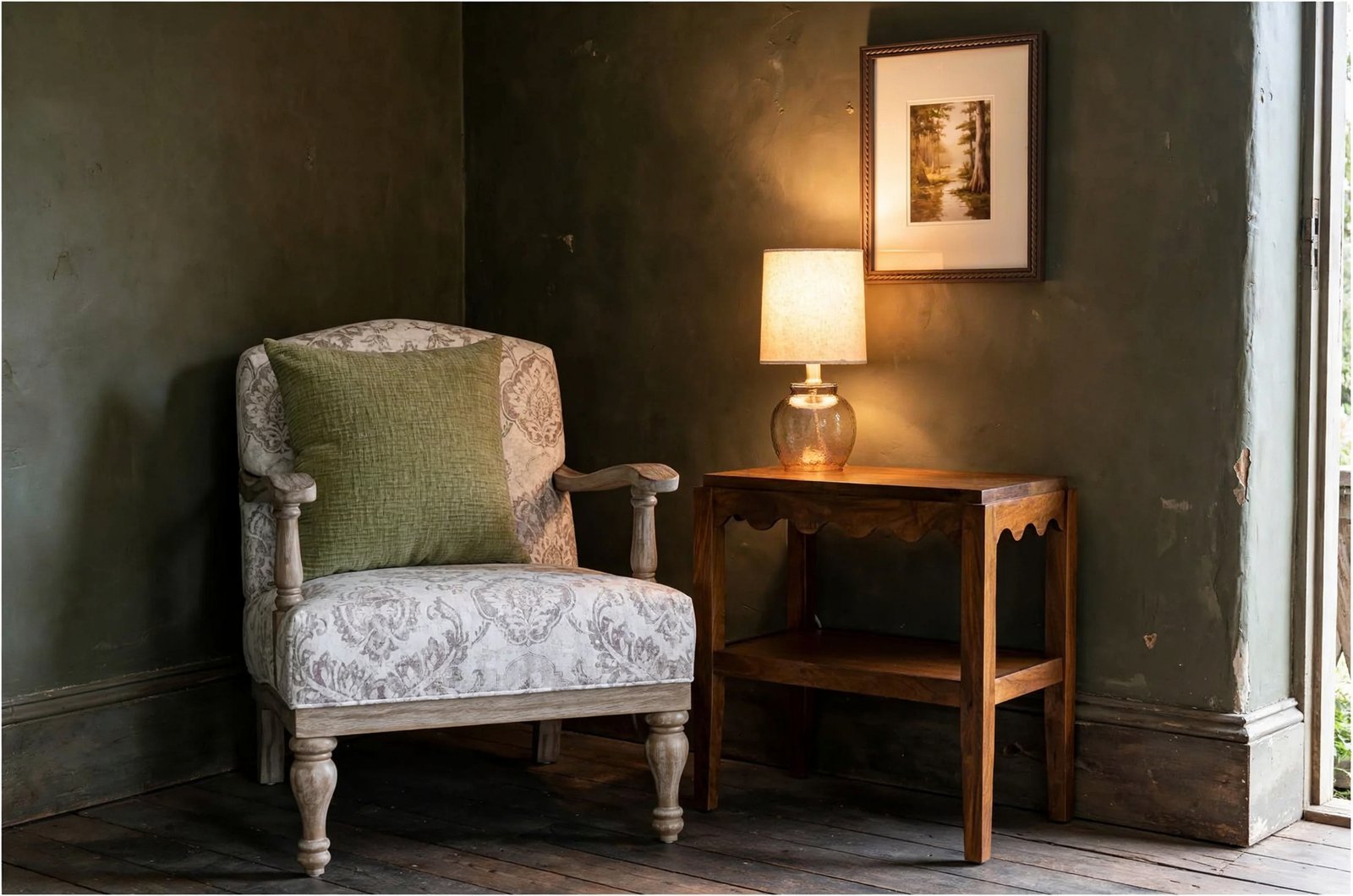
Start in an existing olive corner: a light-weathered open-arm farmhouse chair in beige damask, a mossy sage chenille pillow, and a generously sized chestnut scalloped table under a compact smoky-glass lamp. A small river landscape hangs on Pewter Green plaster. Sample the wall first; the chair’s wood is a pale natural wash, not a dark stain, and the table is wide and shallow, nearly as wide as the chair.
Bulb.Type A 40W A19 LED two-pack, Hobby Lobby, $3.99. The lamp asks for a Type A, 40-watt bulb; check that the base fits.
The four Hobby Lobby accessories total $48.16 before tax and shipping — a useful subset, not the cost of the whole nook. Hobby Lobby’s free-shipping banner is $69, so this smaller accessory order usually carries a delivery charge. All six listed pieces: $928.14, or $993.14 with the chair surcharge, before shipping, tax, and paint.
Look 2 — Smoky navy botanical nook
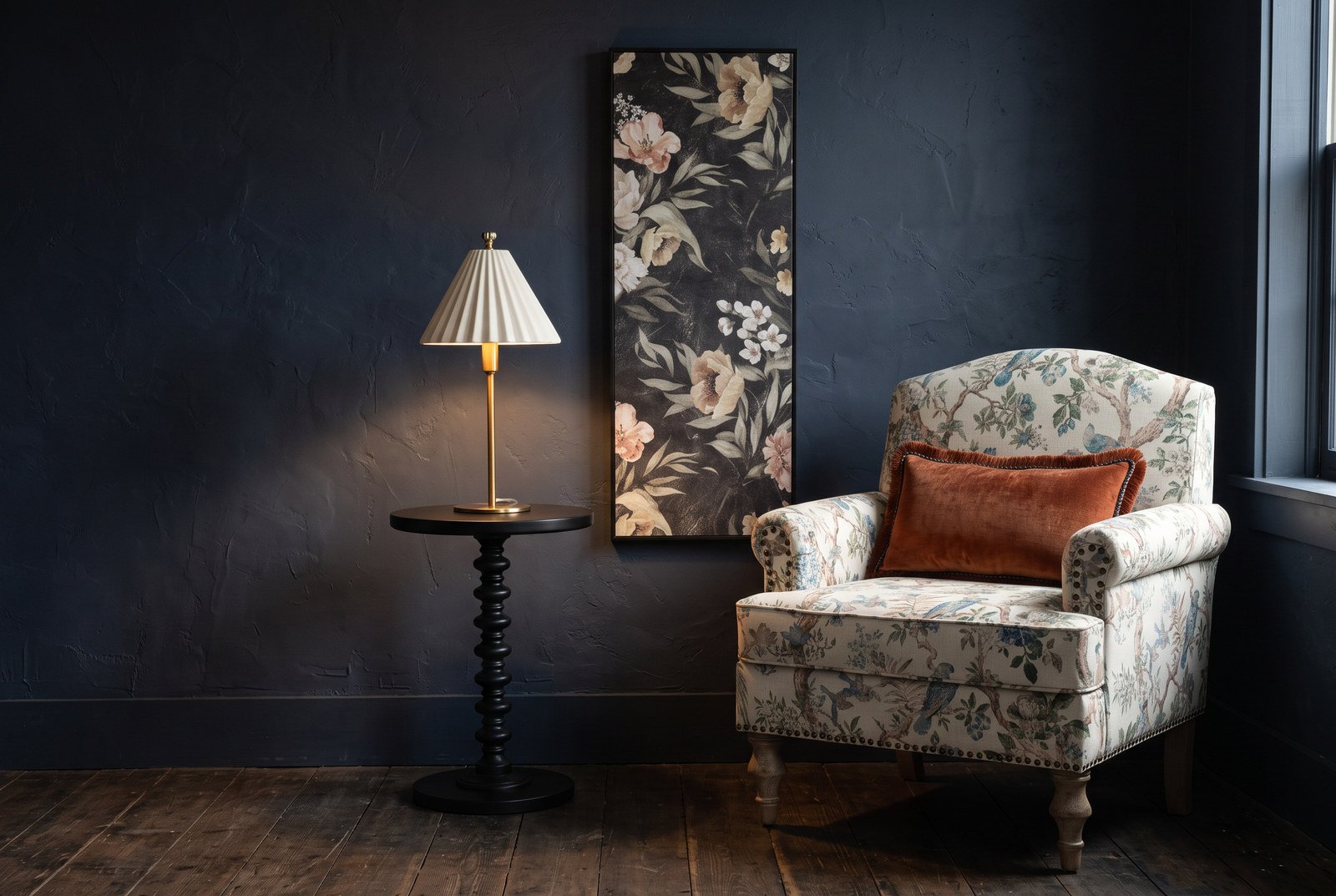
A smoky navy corner holds an ivory botanical-bird roll-arm chair, a rust fringed lumbar, and a small black bobbin table. A petite antique-brass lamp with an ivory ceramic shade sits beside a tall, narrow dark floral panel — almost chair height, so keep that scale in the picture.
Five pieces: $683.55, or $748.55 with the chair surcharge, before shipping, tax, bulb, and paint.
Look 3 — Muted aubergine gold-linen nook
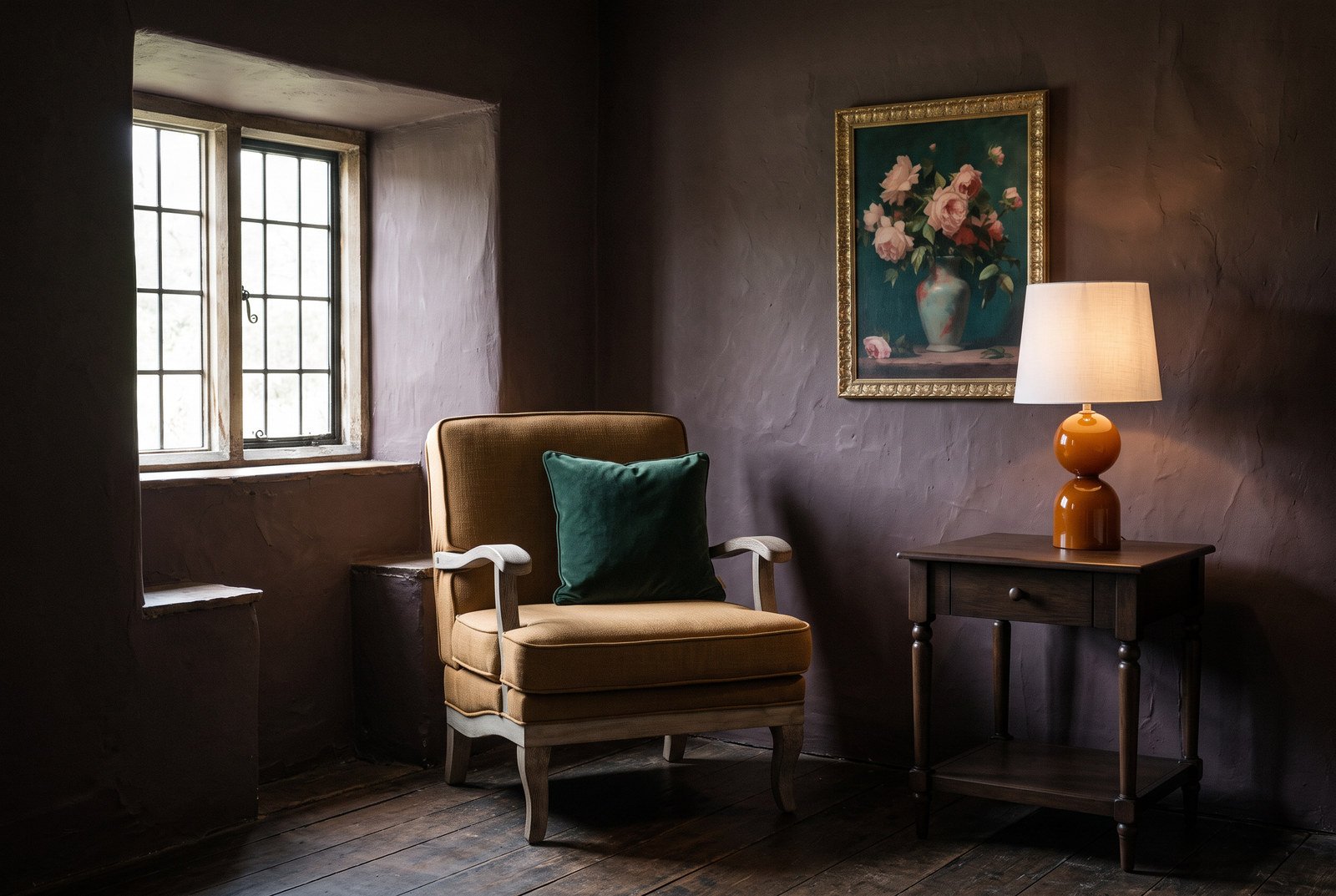
Muted aubergine walls set off a gold linen open-arm chair on light weathered wood, a forest-green velvet pillow, and an espresso turned-leg storage table. An amber milk-glass lamp with a linen shade warms the corner under a gold-framed rose still life.
Shop the look (similar, not exact):
Paint sample.Farrow & Ball Brinjal No.222, 100 ml Estate Emulsion sample pot, $9.00. Test a patch first; the optional US gallon is $160 after you are sure of the color.
Chair.Alamea Gold Linen Exposed Wood Chair, World Market, $449.99. 28″W × 31.5″D × 35″H. Shipping only; +$65 oversized surcharge. The wood is light and weathered.
Five pieces: $892.75, or $957.75 with the chair surcharge, before shipping, tax, bulb, and paint.
Look 4 — Warm charcoal floral-wingback nook
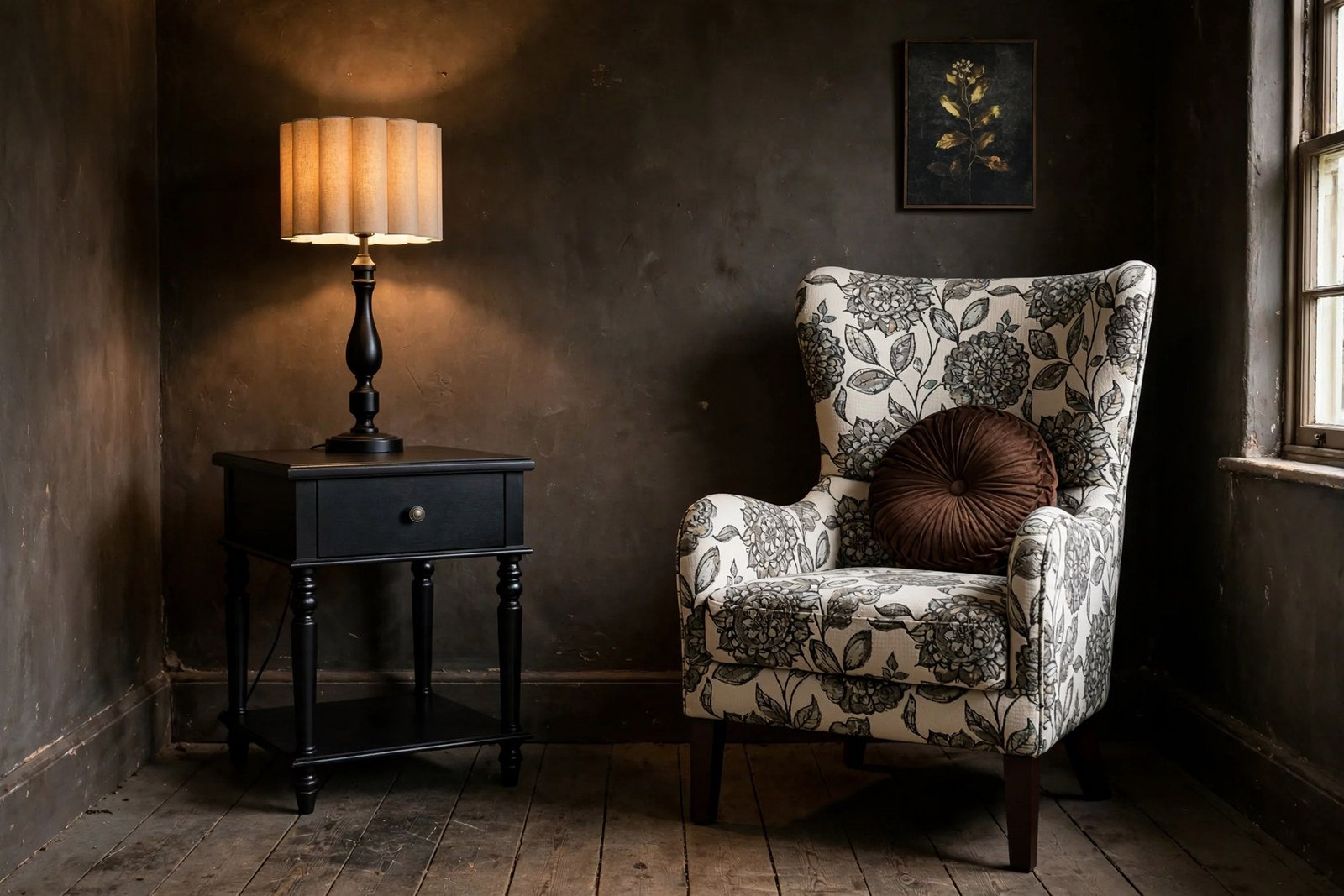
Warm charcoal walls and a tall cream-and-charcoal floral wingback make this the loftiest chair of the six. A chocolate tufted round pillow sits in the seat, and a glossy black turned-leg table holds a tall black-wood lamp with a cream scalloped shade — the lamp stands taller than the chair. A small gold-leaf botanical stays small on the wall.
Five pieces: $963.35, or $1,028.35 with the chair surcharge, before shipping, tax, bulb, and paint.
Look 5 — Oxblood under-stair velvet nook
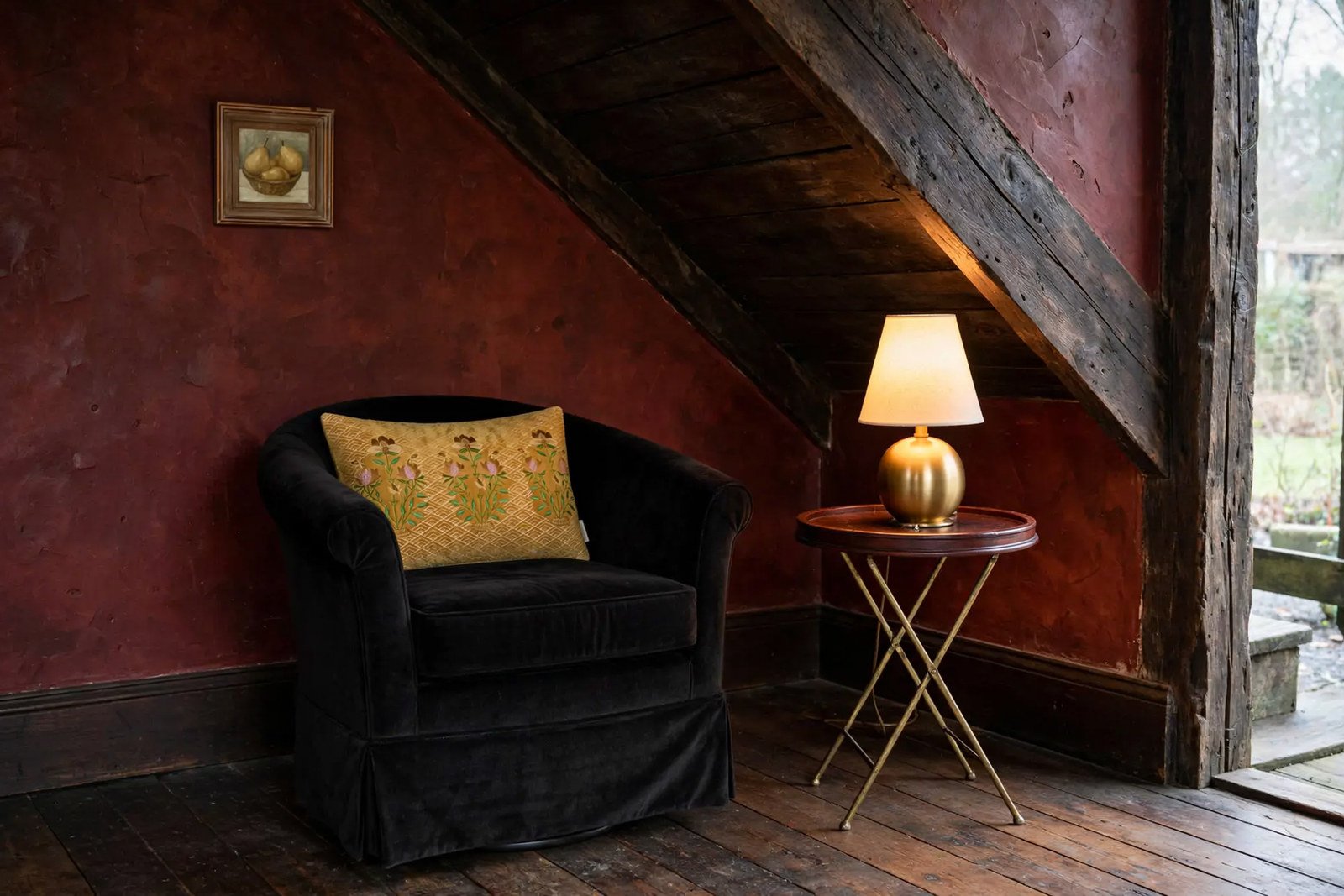
Tuck this one into an existing under-stair recess: a short black velvet barrel chair, a mustard-gold embroidered lumbar sized to the 19-inch seat, and a petite dark-wood tray table on gold folding legs. A mini brass orb lamp pools a little light on the tray, and a 9.5-inch pear still life stays truly small on the wall.
Five pieces: $680.75, or $760.75 with the chair surcharge, before shipping, tax, bulb, and paint.
Look 6 — Dark tobacco window-recess ochre nook
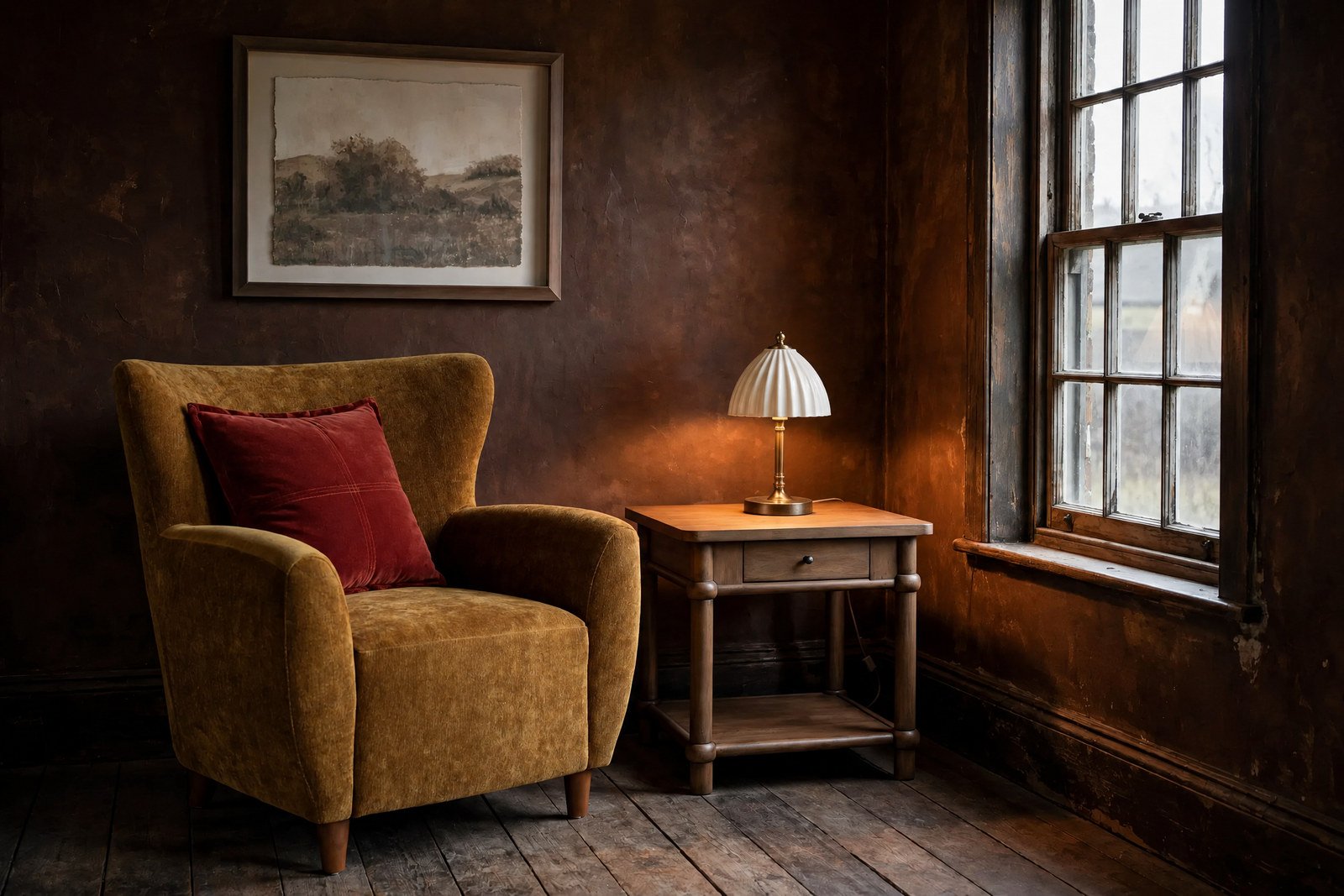
A dark tobacco window recess holds a low ochre chenille wing chair, a brick-red grid pillow, and a clove-brown square wood table. The lamp is the same traditional Ivy brass-and-ceramic piece as Look 2. A muted, wide-matted landscape hangs nearby.
Affiliate disclosure: This post contains affiliate links. We may earn a commission through these links.
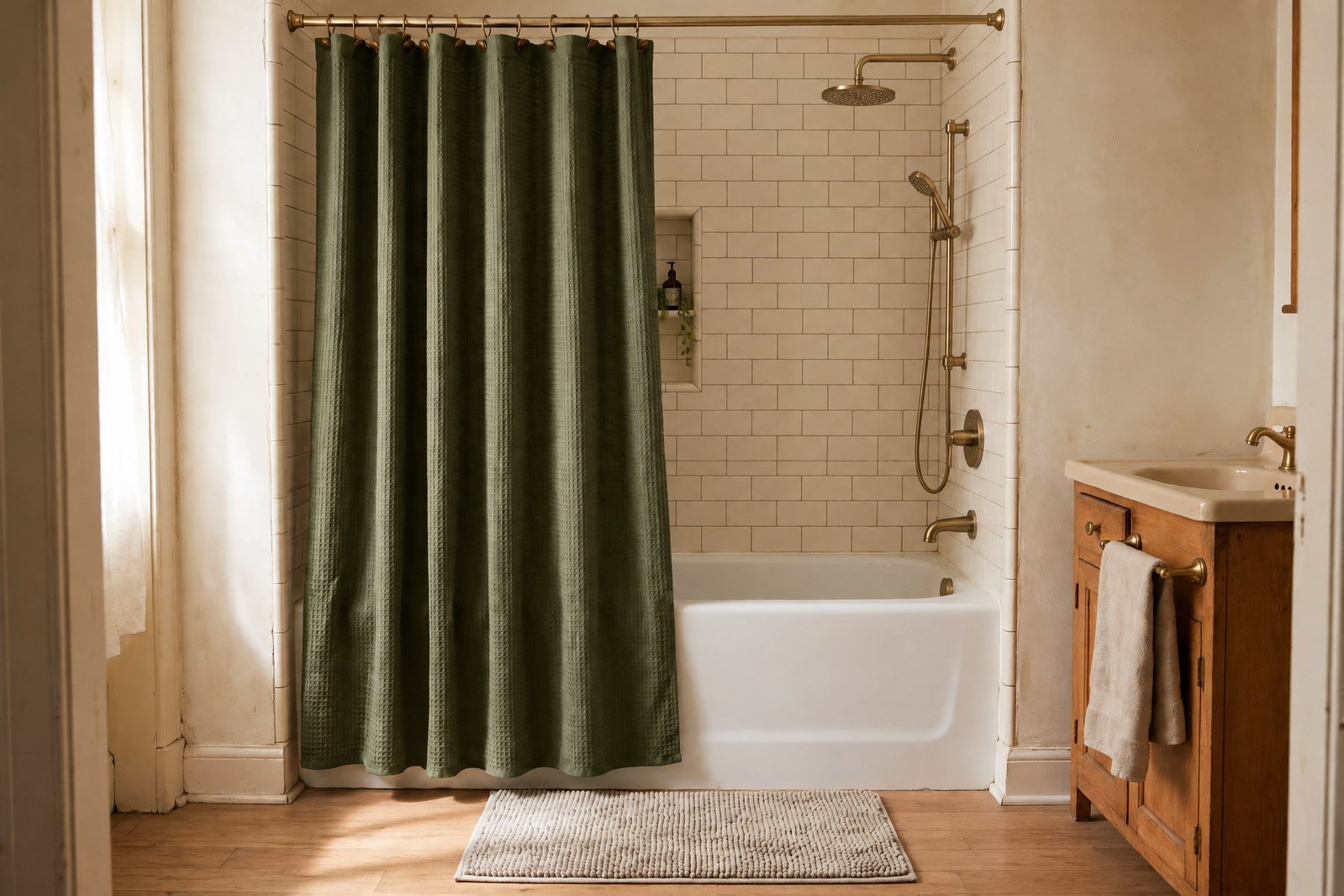
A dark olive curtain and a warm beige mat bring a quieter, earthy mood to an ordinary tub-shower bathroom. Keep the built-in tub, existing tile and fixtures; let the fabric and floor texture change the feeling instead of planning a renovation.
Image note: This AI-generated room image is styling inspiration, not a photograph of the actual products.
Let the curtain set the mood
The dark olive curtain supplies the deepest color without changing the walls. Its waffle weave adds texture, while the beige mat keeps the floor from becoming another dark block.
The selected Threshold curtain is 72 by 72 inches, made from 60% cotton and 40% recycled polyester. It is machine washable and tumble dryable. Measure your opening and hanging height before ordering rather than assuming this size will fit.
Hooks or rings are not included, so check what you already have before ordering. As a practical precaution, we recommend pairing the fabric curtain with a separate shower liner.
Keep the floor softer and lighter
The beige TOFTBO adds a lighter patch beside the tub. The selected mat measures 20 by 31 inches and uses polyester microfiber; IKEA lists machine washing and low-temperature tumble drying.
Check that its footprint works with your door swing and available floor space. The small rectangle brings warmth to the floor without needing to match the curtain exactly.
Keep the rest of the room
Start with this pair and leave the fixtures alone. Existing timber or dark hardware can carry the farmhouse mood without adding more things to buy. Check the retailers’ current sizes, care instructions, availability and prices before choosing your pair.
This post contains affiliate links. As an Amazon Associate I earn from qualifying purchases.
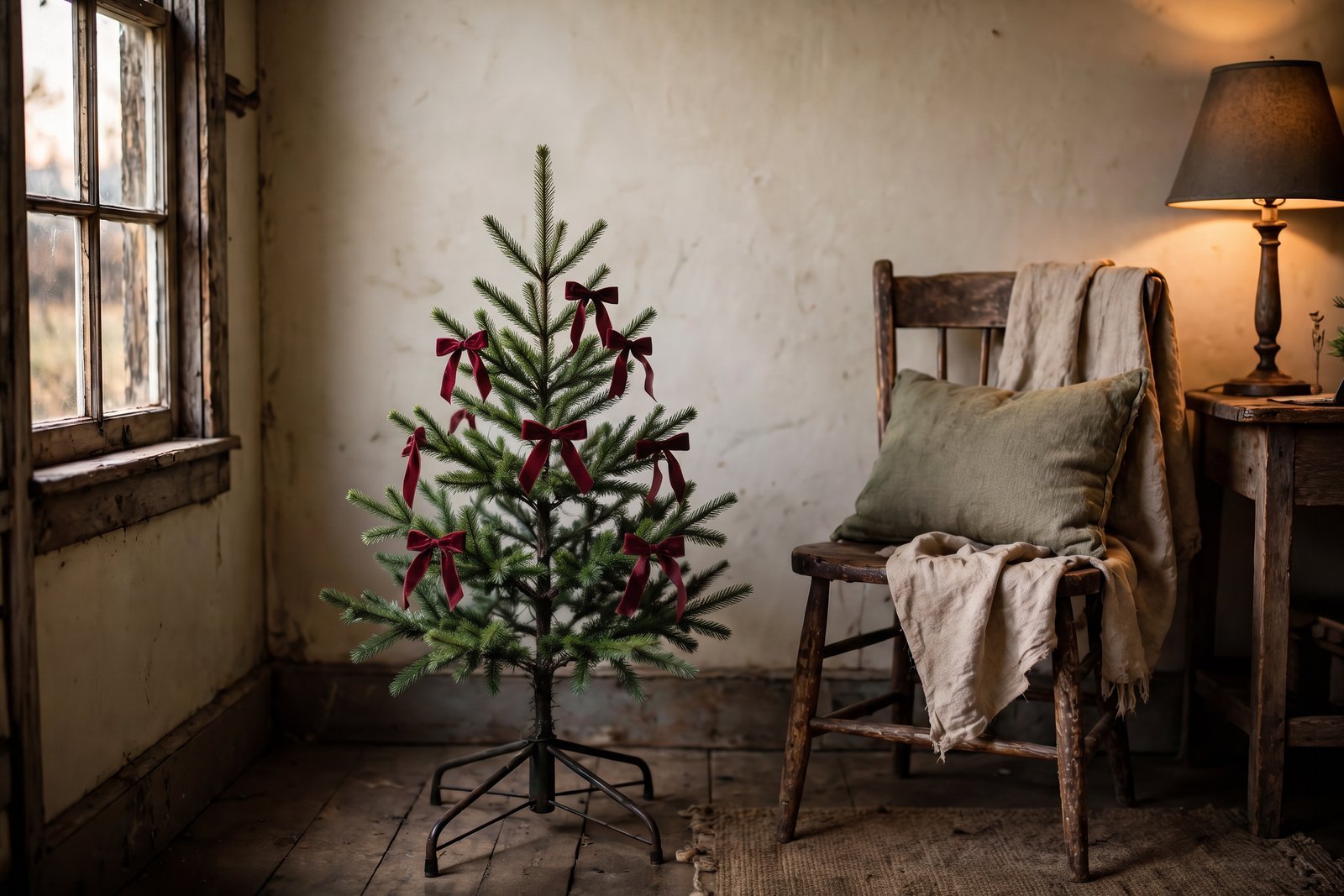
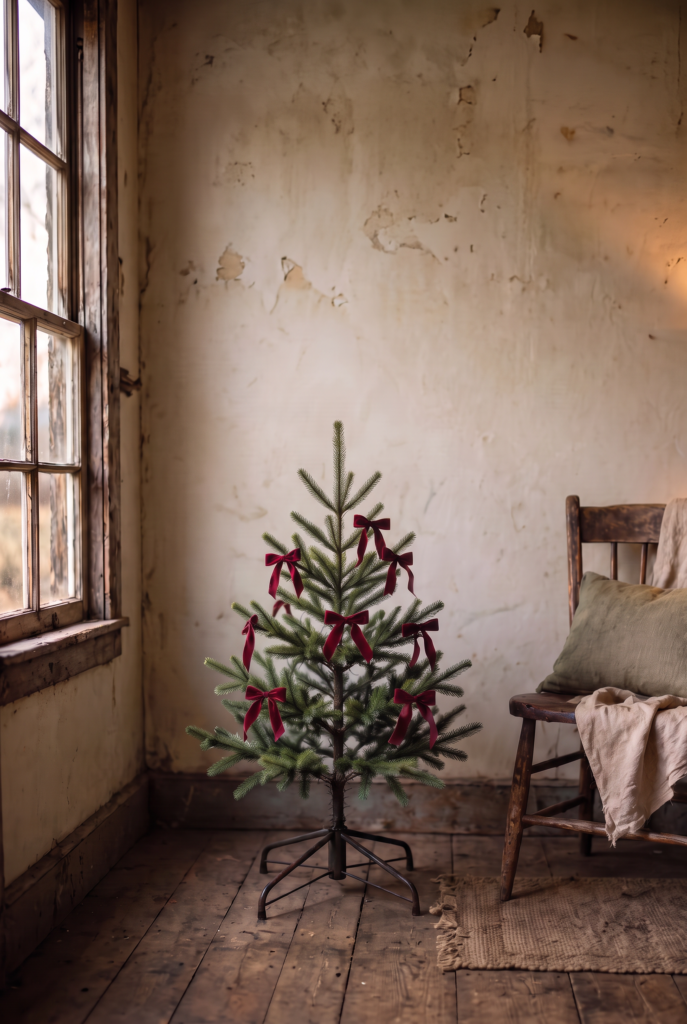
A dark cottage Christmas in a small home does not need a floor-to-ceiling tree. It can live in one quiet corner: a table, a chest, or the edge of the hearth, dressed with a compact green tree and a few soft burgundy bows.
The images here are AI-generated decorating inspiration, not product photography, and they are not pictures of the exact items linked below.
A 3-foot unlit mini tree for a tight corner
This look starts with a small, unlit tree you can place and then decorate yourself. The JTSIOV 3-foot green mini tree is an unlit artificial pine-and-fir style tree in emerald green, with PVC tips, a metal trunk, and a four-legged foldable stand. The listed footprint is about 12 inches by 12 inches, and the height is 3 feet, so it can sit on a tabletop or a low chest without taking over the room.
Because it arrives unlit, the glow can come from the room — a nearby lamp, a candle on a safe surface, or lights you add later — and the bows stay the main accent. Fluff the branches after you set the stand, then keep the styling close and simple.
Soft burgundy velvet bows, not stiff wired loops
The second piece is a deep burgundy ribbon meant for soft, hand-tied bows. The Ribbli 1-inch burgundy velvet ribbon, in the Burgundy and 1-inch options, is a 10-yard continuous spool of single-faced polyester velvet. One side is plush; the reverse is flat. It is not wired, so the bows drape instead of standing in crisp loops — a quieter finish for a small cottage tree.
Decorating inspiration, AI-generated. Not a photograph of the ribbon linked in the post.
Cut modest lengths, tie them where the eye already rests — near the tip, a mid-branch, or around the base — and leave the rest of the tree a little bare. Ten yards is enough for several bows without crowding a 3-foot silhouette.
What’s Selling on Pinterest Right Now
A compact holiday corner you can actually buy and style: a mini tree and one rich ribbon, not a whole-room overhaul.
Keep the scene small, then shop the two pieces
This is a two-product scene, not a full-home Christmas guide, and the images are decorating inspiration rather than a promise that any room will match them exactly. When you are ready to gather the pieces, start with the 3-foot unlit JTSIOV mini tree and the Ribbli burgundy 1-inch velvet ribbon.
This post contains affiliate links. If you buy through one of them, I may earn a commission at no extra cost to you. (paid link) As an Amazon Associate I earn from qualifying purchases.
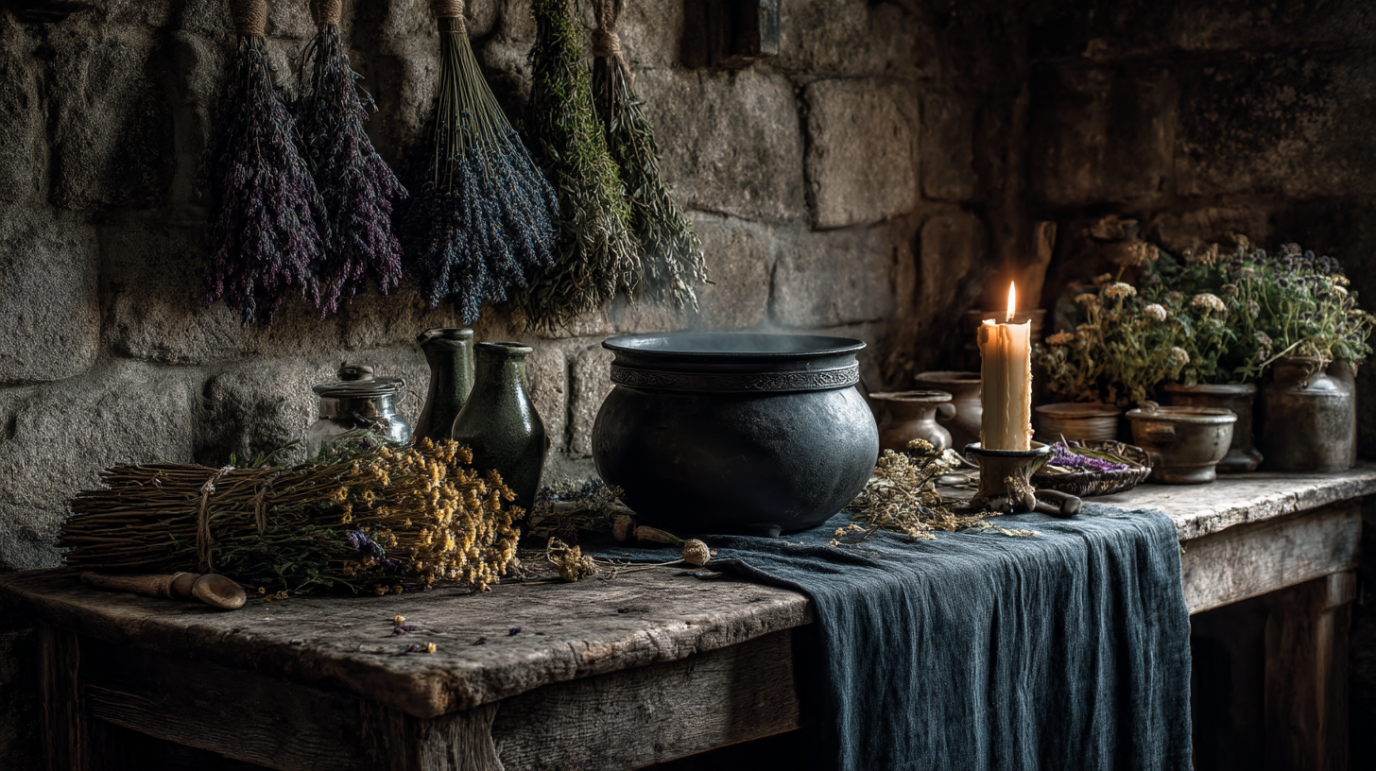
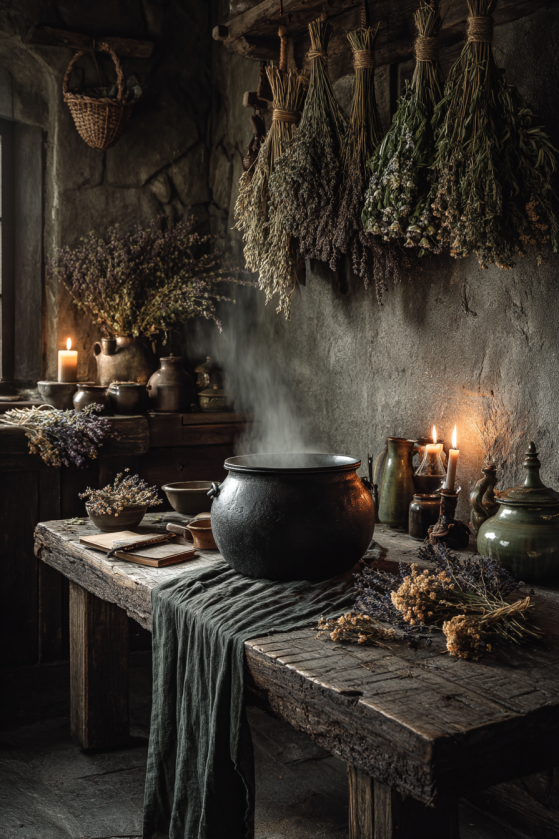
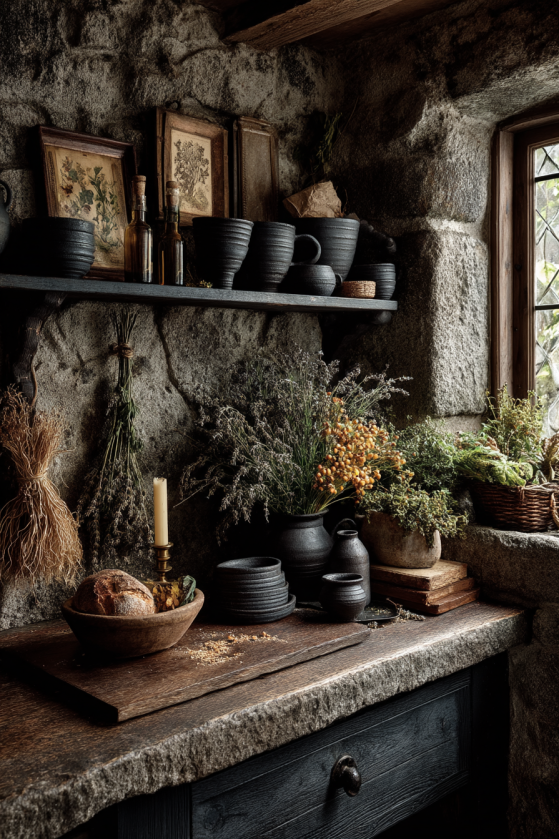
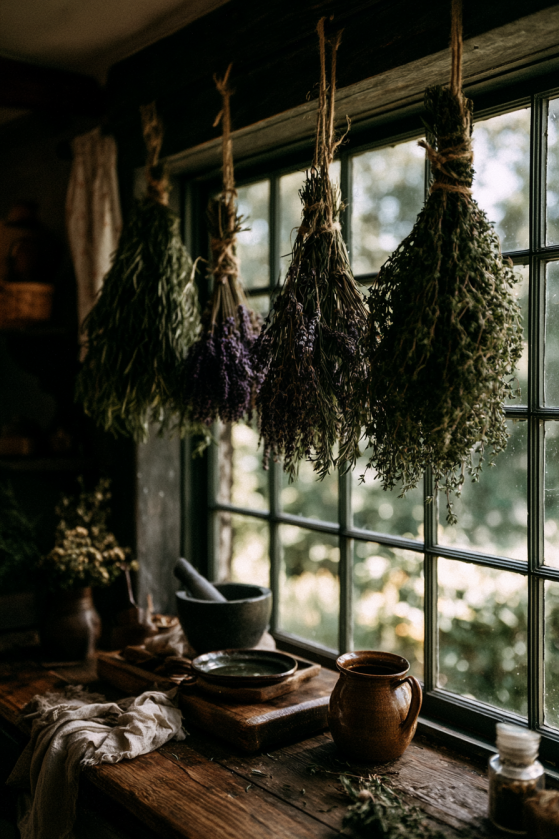
Step inside. The kettle hums low on a black iron stove. Bundles of dried lavender and rosemary hang like sleeping bats from a ceiling beam worn smooth by decades of hands. A single tallow candle stutters on the windowsill, casting amber pools across dark slate tiles and a worn oak table dusted in flour.
This is not your grandmother’s farmhouse kitchen.
This is something older. Something more honest.
This is the dark cottagecore kitchen aesthetic — and if your soul has ever ached for a place that feels both wildly beautiful and beautifully strange, you already know exactly what this feels like.
What Is the Dark Cottagecore Kitchen Aesthetic?
Cottagecore, at its heart, is a love letter to slow living, handmade things, and the natural world. But dark cottagecore dips that letter in ink instead of watercolor.
Where classic cottagecore kitchens lean toward white linen and sunlit jars of honey, the dark cottagecore kitchen leans into:
Deep, moody color palettes — forest green, charcoal, blackened walnut, plum, and stone grey
Witchy, foraged, and folk-magic vibes — dried herb bundles, mortar and pestles, amber glass bottles, beeswax candles
A sense of living with the land, not just decorating with it
Gothic undertones softened by the warmth of a wood fire and the smell of bread baking
Think: a healer’s cottage at the edge of a dark wood. A Victorian herbalist’s workspace. A fairy tale kitchen where something is always simmering and the walls know your name.
The objects that carry this feeling are not loud. They are the ones that have already been used — the iron that has seasoned with other fires, the clay that holds its own silence, the herbs that dried in their own season. You can bring that same weight and quiet into your own kitchen.
LAYER YOUR OWN DARK COTTAGECORE KITCHEN
The pieces that make the room feel like it has always been yours are the ones that have already lived. Here are the exact elements you see in the images above, ready for your own kitchen.
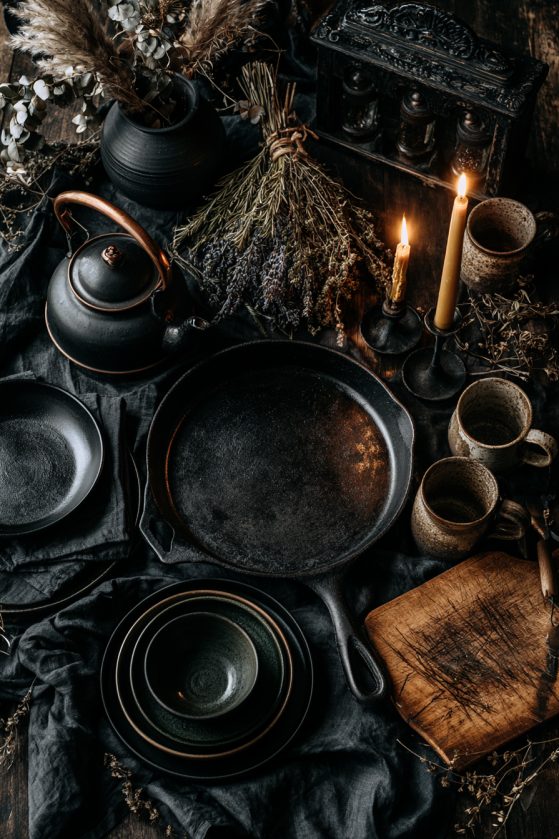
Black Cast Iron Pot – The black cast iron pot that sits heavy on the table, steam rising as if it remembers every meal it has held — a well-seasoned cast iron Dutch oven brings the same grounded presence (Amazon).
Cast Iron Ritual Cauldron – Embrace the magic with this rustic cast iron ritual cauldron, perfect for your altar, burning incense, and blending sacred herbs.
Bundles of Dried Hurds – Bundles of dried lavender and rosemary hanging from the beam, their scent still in the air long after the kettle has quieted — these dried herb bundles add the same quiet life to any space (Etsy).
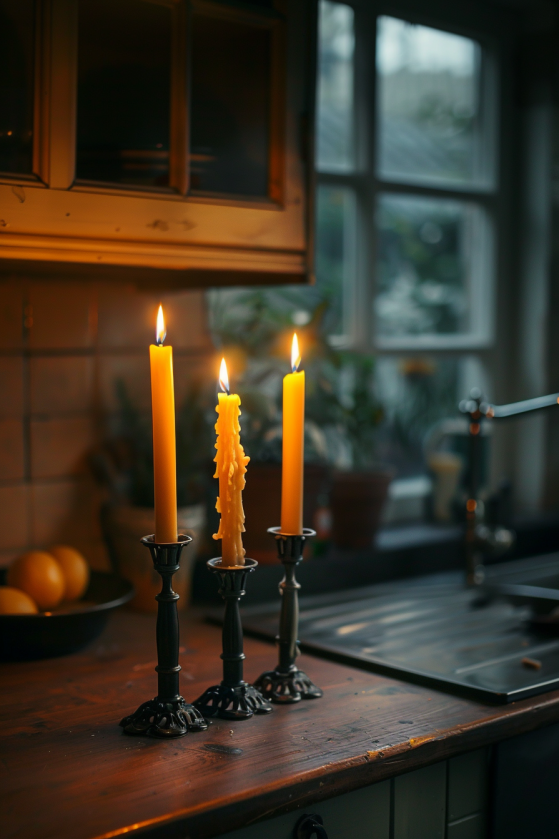
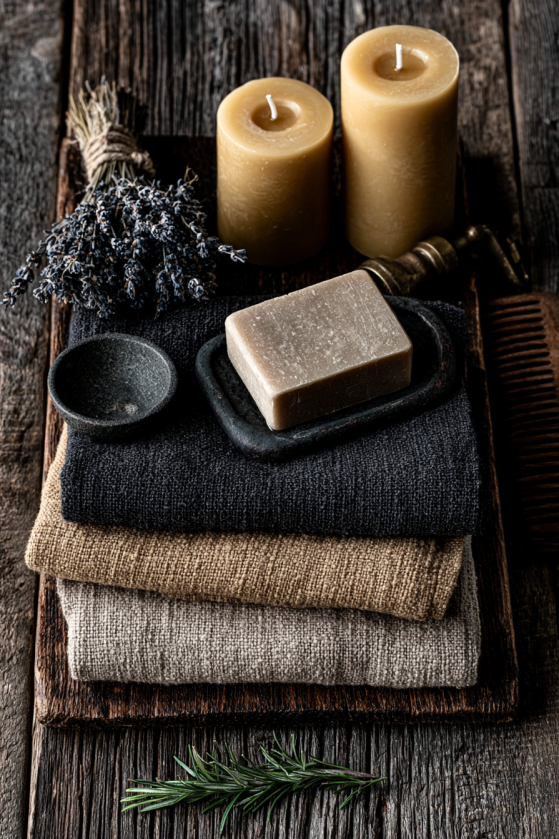
Beeswax Taper Candles, 8 in, 6 Pack (paid link) – The beeswax candle burning low in its holder, light that doesn’t rush the room — pure beeswax tapers in simple iron holders create that same soft, living glow (Amazon).
Mix and Match Black Clay Artisanal Pottery – Dark stoneware crocks, bowls, and mugs lined on the open shelf — stoneware pieces that feel good in the hand and look like they have always belonged (Etsy).
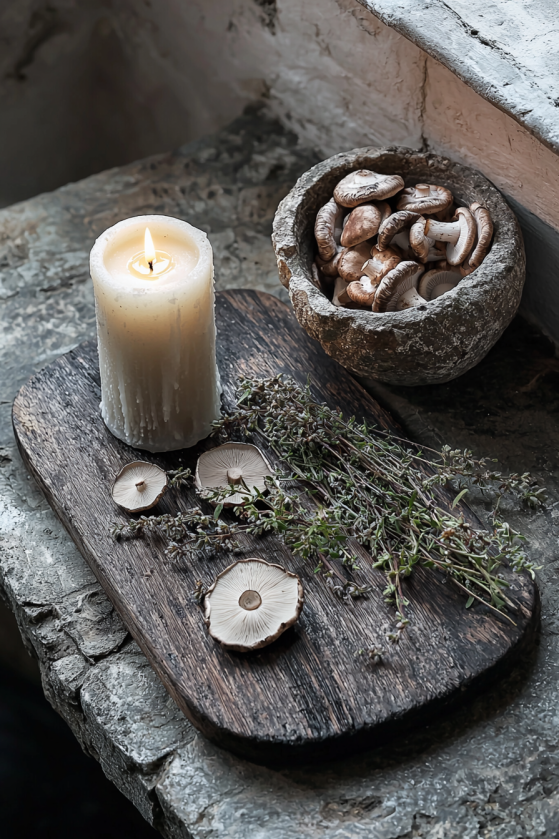
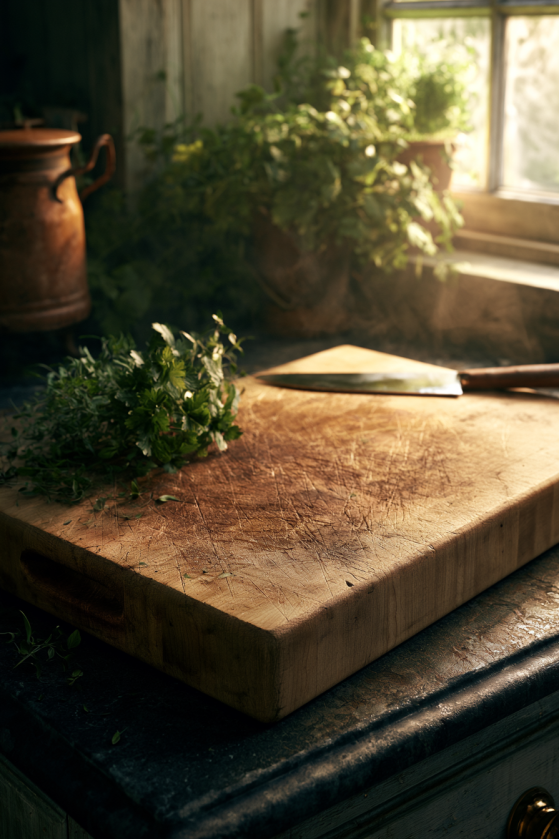
Granite Mortar and Pestle Set, 2-Cup (paid link)– The stone mortar and pestle on the wooden board with thyme and mushrooms — a simple stone mortar and pestle for the daily work of the kitchen (Amazon).
Framed Botanical Prints – Framed botanical prints above the shelf, small stories from the land — botanical art prints in dark wood frames bring that same grounded detail to the wall (Etsy).
This post contains affiliate links. If you buy through one of them, I may earn a commission at no extra cost to you. (paid link) As an Amazon Associate I earn from qualifying purchases.
There’s a particular kind of morning that belongs to the dark cottagecore kitchen.
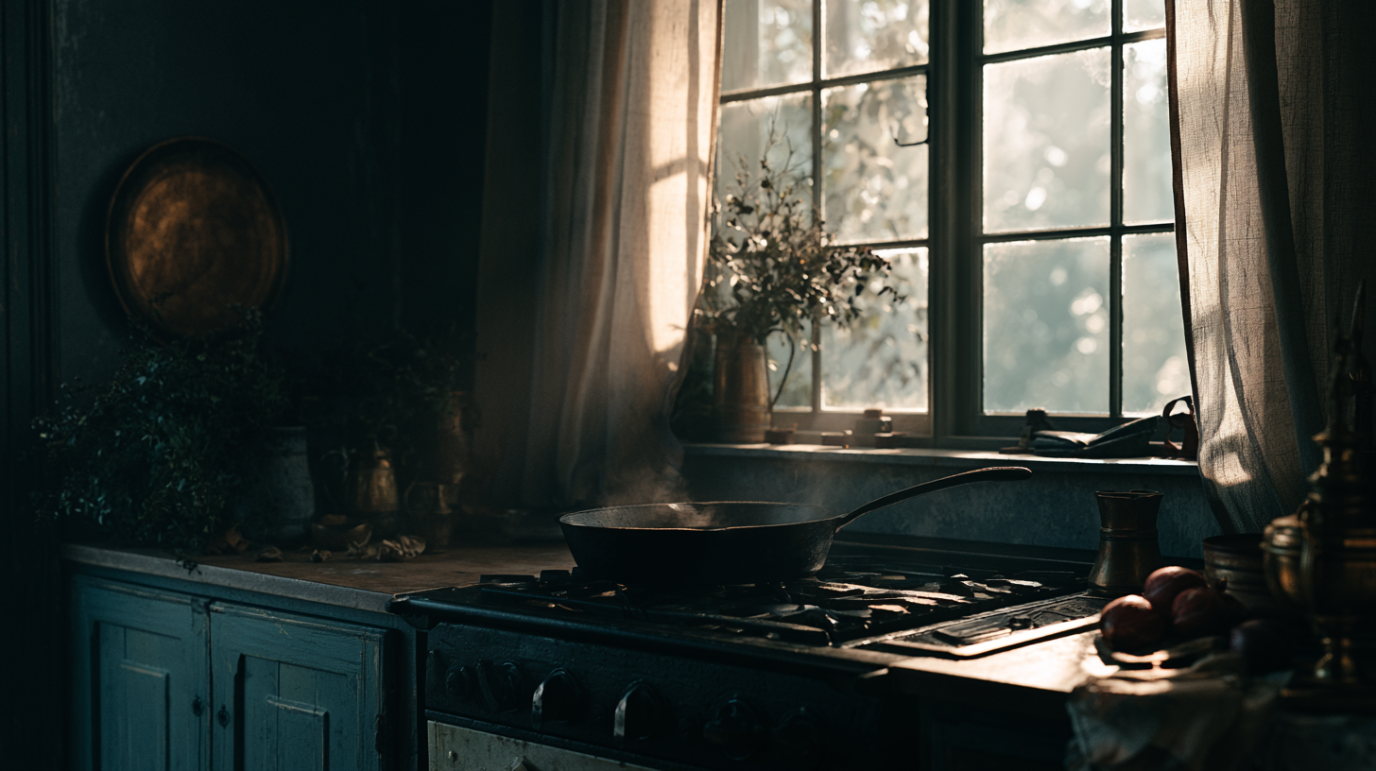
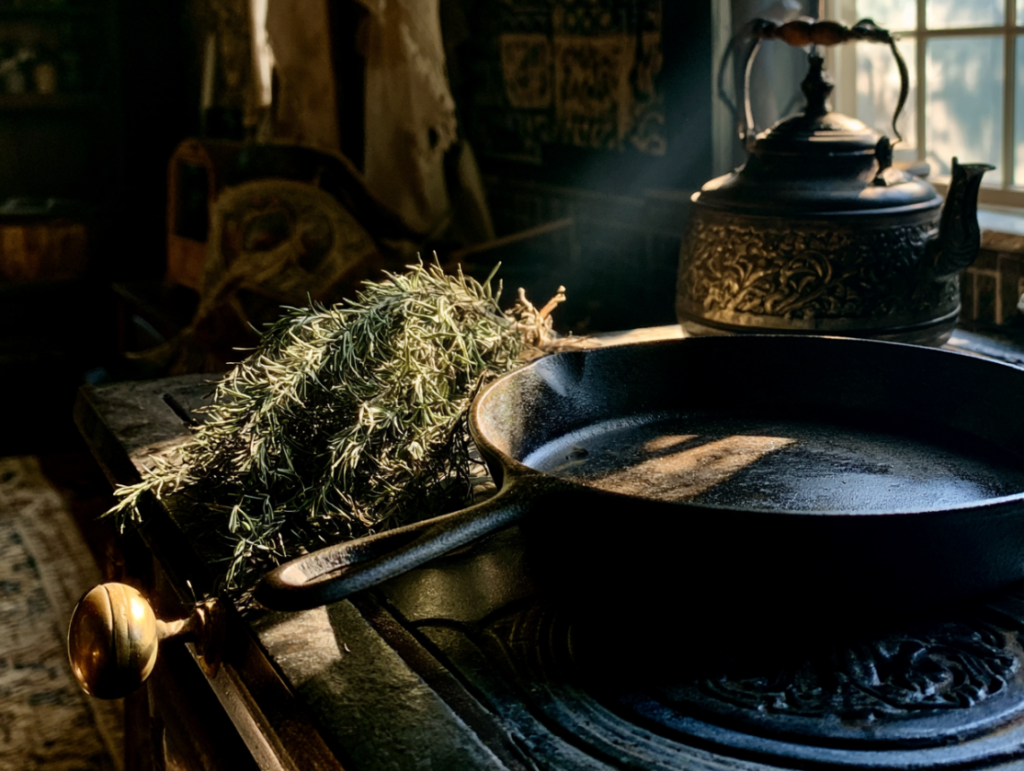
The kind where cold grey light filters through linen curtains. Where a cast iron skillet sits heavy on a gas flame. Where the whole room smells of woodsmoke and black coffee and something faintly herbal — dried rosemary, maybe, or the last of the lavender bundles hung upside down above the window.
If you’ve ever wanted your kitchen to feel less like a showroom and more like a place where something slow and magical is always simmering — you’re in the right place.
Dark cottagecore kitchens aren’t afraid of shadows. They welcome them. They lean into worn textures, deep colors, candlelight, and the kind of utilitarian beauty that comes from using real tools in a real kitchen.
Here are ten essentials that will make your kitchen feel like it belongs in a fairytale farmhouse at the edge of a dark wood.
Disclosure: This post contains affiliate links. If you purchase through these links, we may earn a small commission at no extra cost to you. We only recommend products we genuinely love.
1. A Well-Seasoned Cast Iron Skillet
Nothing grounds a dark cottagecore kitchen like cast iron. Heavy, dependable, quietly beautiful in the way only things with history can be. A good cast iron skillet develops character with every use — it’s seasoned by your cooking, not by a factory. Lodge makes legendary skillets that last generations. Place it on the stove even when it’s not in use. It belongs there.
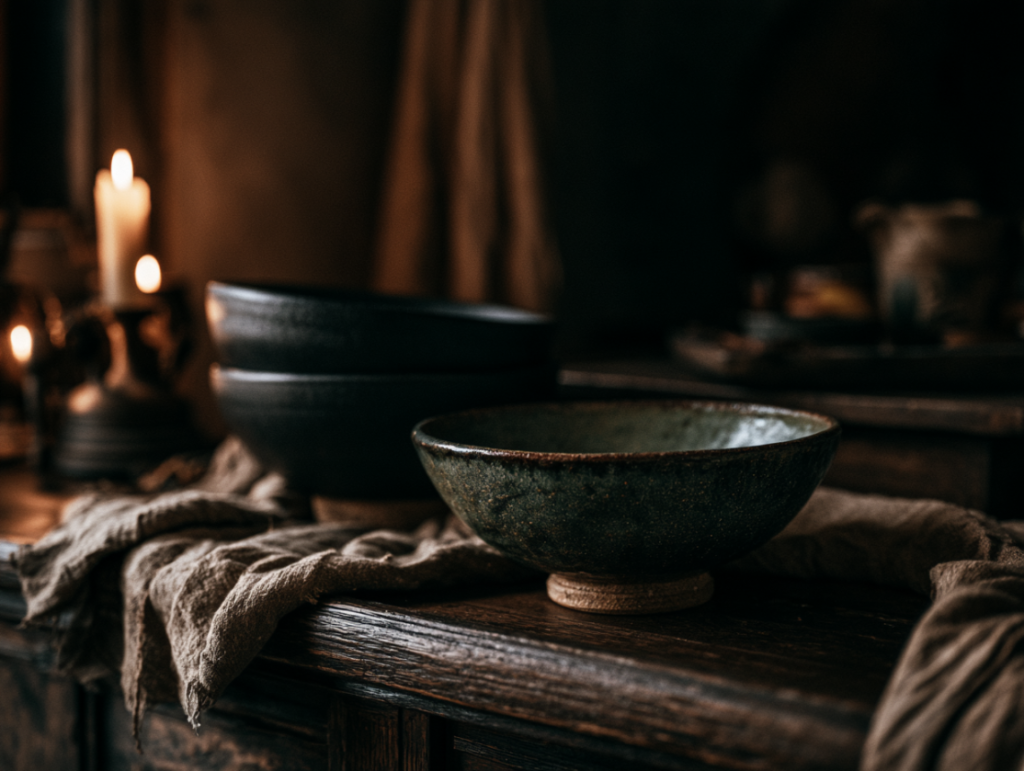
Step away from stainless steel. Dark ceramics — in deep slate, matte black, or moody forest green — carry the handmade, earthy energy of cottagecore without sacrificing function. Look for a nesting set you can leave on the counter. They’re art when empty and joy when full of bread dough.
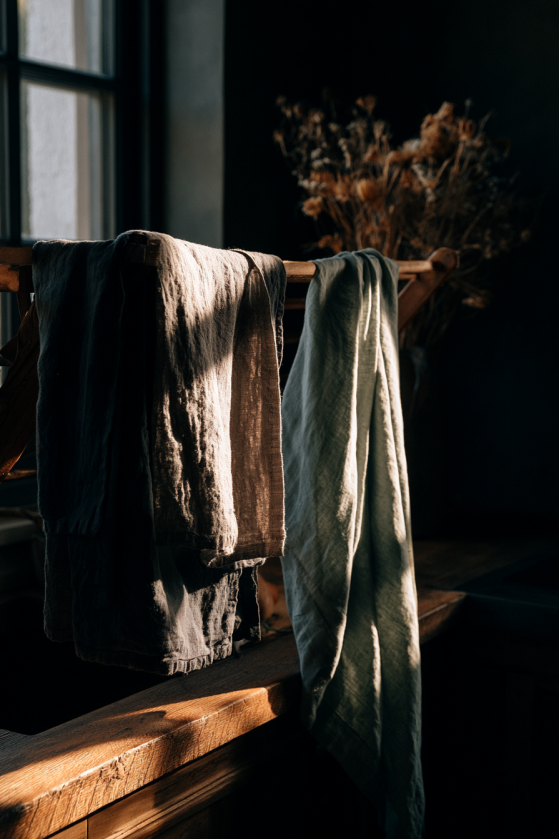
Charcoal. Oatmeal. Dusty sage. Washed-linen tea towels drape over oven handles and fold over wooden drying racks in a way that makes the whole kitchen feel like a still life. They should look like they’ve been washed a hundred times and are better for it.
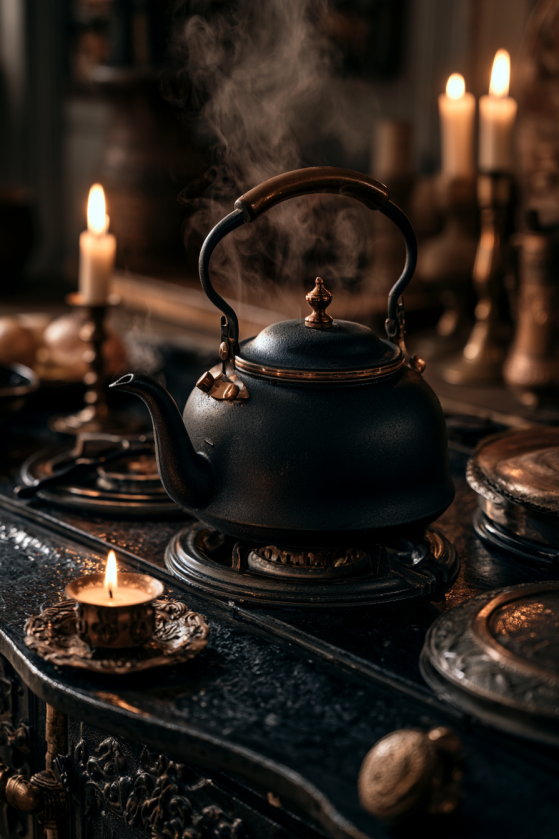
There is something almost ceremonial about a beautiful kettle on the stove. A matte black enamel kettle or a hammered copper one catches the morning light differently than plastic will ever manage. Boil your water slowly. Let it be a ritual.
This is both decor and pantry. Hang dried rosemary, lavender, thyme, and sage bundles from a ceiling hook or a wooden dowel above the kitchen window. They perfume the air with something ancient and practical. You can forage your own or buy beautiful pre-dried bundles from herbal suppliers on Etsy.
Dark cottagecore kitchens are not fluorescent. In the evening — even just for dinner prep — light a taper candle. Beeswax burns cleaner and smells faintly of honey and wildflowers. Simple wrought-iron holders or turned wooden ones are all you need.
Not a pristine end-grain showpiece. A wooden board with knife scars and oil stains and a story. Edge-grain maple or walnut boards develop a patina over years of honest use. Let them. Boos Blocks are the gold standard for kitchen boards that last decades.
The mug matters. Thick-walled stoneware in forest green, ash grey, or speckled cream holds heat longer and feels grounding in your hands in a way that thin porcelain never will. Small pottery studios and Etsy ceramicists make the most beautiful ones — each slightly imperfect, each unmistakably handmade.
Bring your spice collection out of the cabinet and onto the wall. A small black-painted wooden spice rack hung beside the stove, filled with glass jars and small tins, becomes one of the most atmospheric features in a dark cottagecore kitchen. Label with chalkboard tags or hand-stamped kraft labels.
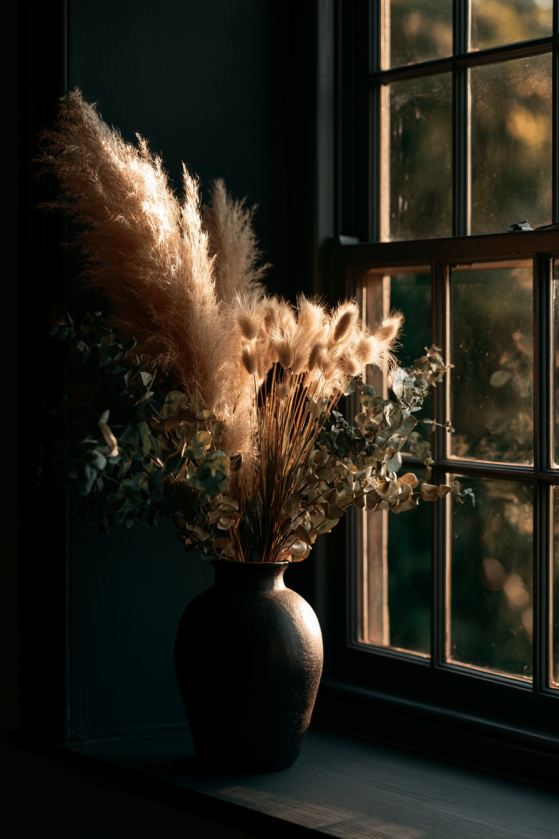
A small bunch of wildflowers in a dark stoneware vase. A cluster of dried pampas grass in a black enamel pitcher. Single stems of eucalyptus in a narrow terracotta pot with a black glaze. Wherever you put them, flowers bring the garden inside and soften the whole aesthetic into something breathing and alive.
The dark cottagecore kitchen isn’t built in a day — it’s assembled slowly, deliberately, the way a good stock is made. One beautiful object at a time. One ritual at a time.
Start with the cast iron and the candles. Let the rest come.
Disclosure: This post contains affiliate links. If you purchase through our links, we may earn a small commission at no extra cost to you. (paid link) As an Amazon Associate I earn from qualifying purchases. We only recommend things we genuinely love.
Every house has a corner that wants to become something more.
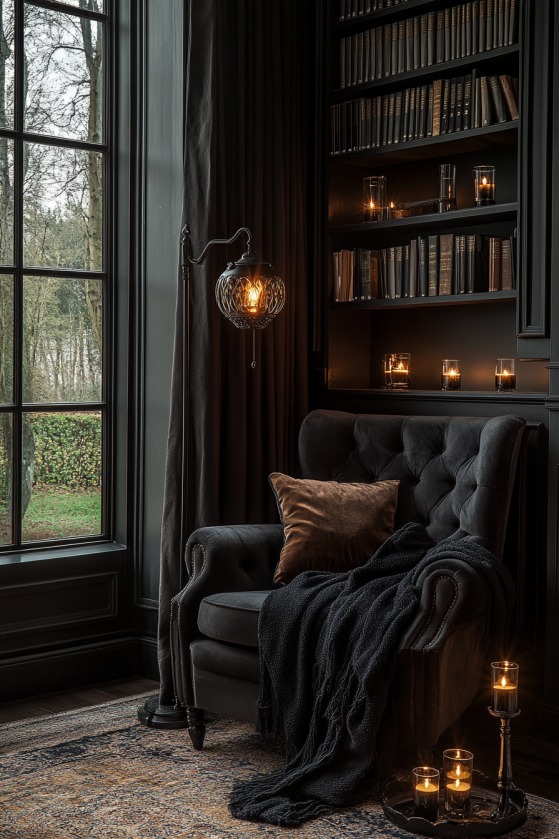
Step 1: Choose a Corner That Has Potential for Shadow
Maybe it’s the deep alcove beside the fireplace. Maybe it’s the window bay in the upstairs room where the light goes amber in the afternoons. Maybe it’s just a quiet patch of wall where something is waiting to be built.
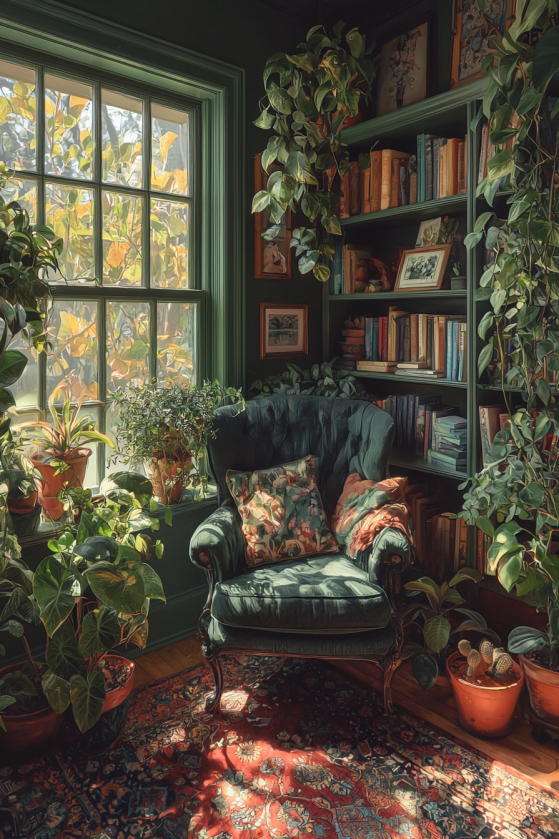
That corner wants to be a reading nook. A dark one.
Not dark as in gloomy — dark as in intentional. Rich. Layered. The kind of space that wraps around you like an old wool coat and makes the rest of the world go quiet.
Light is important in a reading nook — but so is the absence of it. Look for a corner that gets side light rather than overhead light. A window that faces north or catches afternoon shade. A wall nook where a single lamp can carve light dramatically from one direction only.
Avoid spaces under harsh overhead lighting. You can always add warm light to a dark space. You can’t really subtract cold brightness from a too-bright one.
Step 2: Anchor the Space with Dark-Painted Walls or a Rich Wallpaper
If you can paint the reading nook differently from the rest of the room — do it. A single accent wall in deep charcoal, forest green, navy, or warm black creates an immediate sense of enclosure and drama.
If you can’t paint (renting, or you want a softer commitment), consider a removable wallpaper in a botanical or gothic geometric pattern. Dark floral or arch-motif wallpapers are having a major moment and they dramatically elevate a small corner with minimal commitment.
A reading nook without shelves is just a seat. Shelves are what make it a nook.
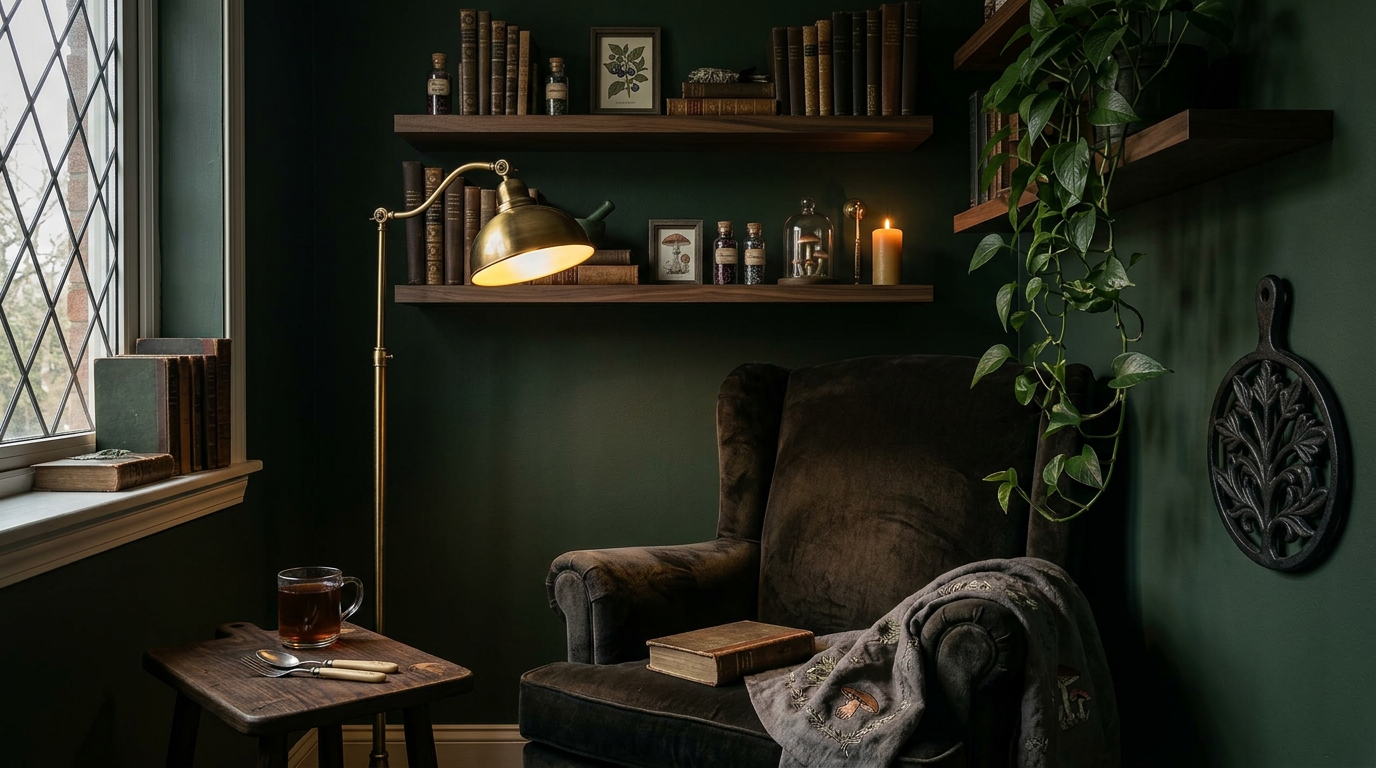
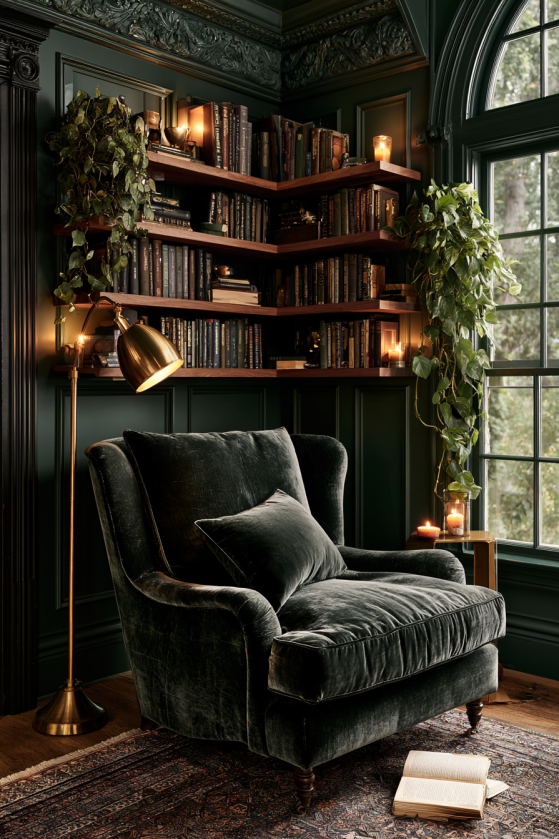
Floating shelves in dark walnut or black-finished wood work beautifully. Stack them slightly asymmetrically — they don’t all need to be the same depth or height. Fill them with books spine-out, a few beautiful objects (a small framed print, a brass candle snuffer, a dark glass bottle), and at least one trailing plant.
The shelves should feel like they’ve been collected over years, not assembled from one shopping cart.
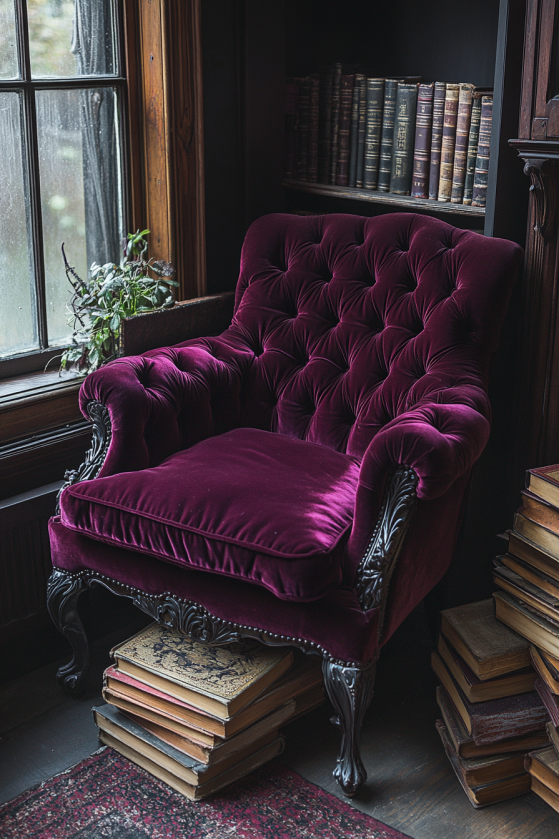
Step 4: Choose Your Seating — Deep and Low
The perfect reading nook seat is deep enough to curl into. Look for:
A low armchair with generous cushioning
A window seat with a thick cushion and bolster pillows
An oversized floor cushion or pouffe beside a low side table
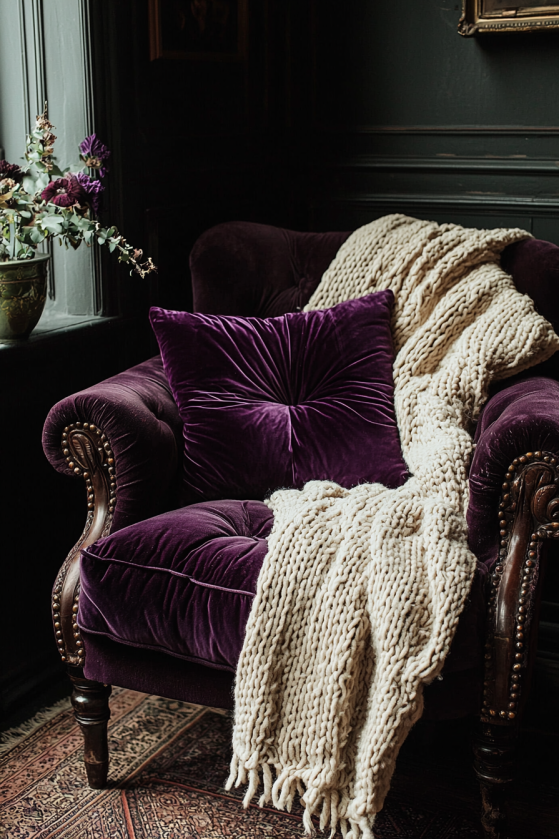
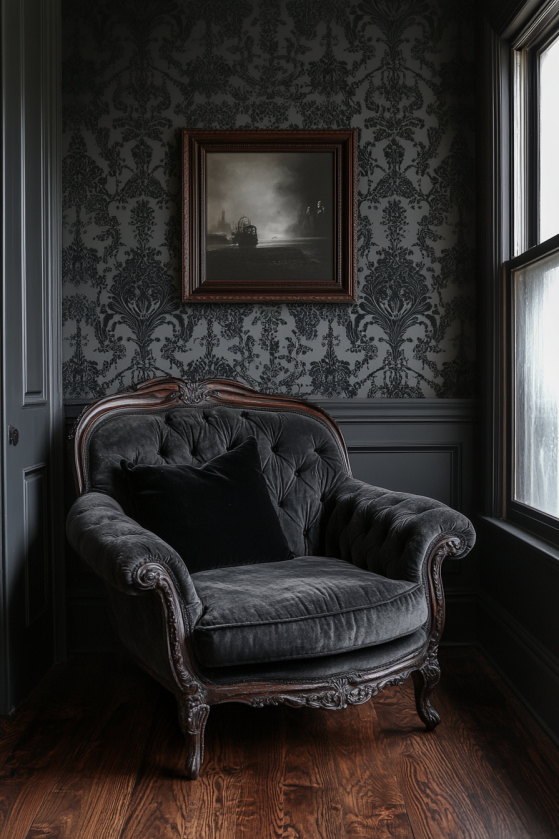
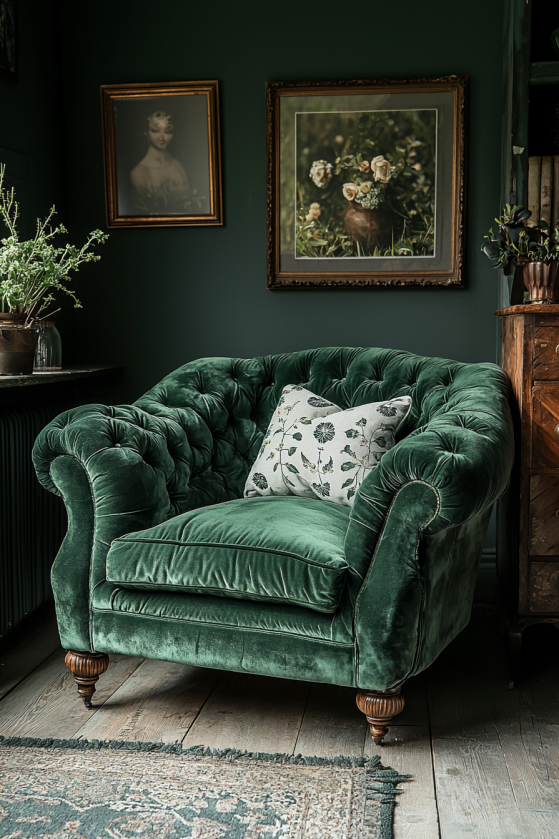
Fabric matters here. Velvet, linen, or aged leather in muted, moody tones — bottle green, dusty plum, charcoal, rust — all work beautifully. Avoid synthetics that don’t age well. You want your nook to look better in three years than it does today.
Step 5: Layer the Textiles
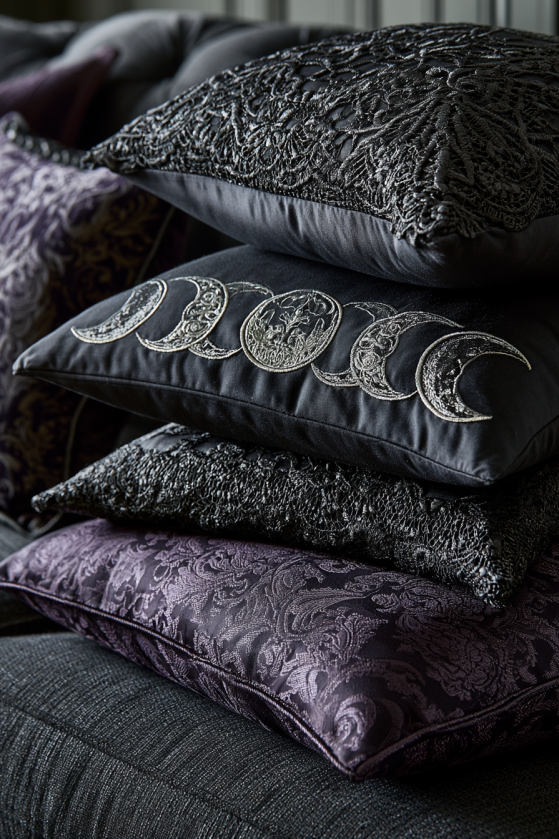
One pillow is not a reading nook. You need:
At least 2-3 throw pillows in different textures (velvet, knit, woven)
A throw blanket heavy enough to actually keep you warm
A rug beneath the chair if the floor is hard
Don’t match everything perfectly. Gothic and dark cottagecore aesthetics reward layering — a velvet pillow beside a cable-knit throw beside a woven cushion is better than a matching set.
Step 6: Build the Lighting System (Not Just One Lamp)
The reading nook has two lighting modes: the reading light and the mood light.
For reading: a clip-on or adjustable arm lamp positioned over your shoulder, bright enough to be practical without flooding the room.
For mood: warm amber fairy lights tucked along the shelves. A beeswax taper on the side table. Perhaps a small salt lamp or amber-glassed lantern in the corner.
When you’re reading, you use the reading light. When you’re not — when you’re just sitting and existing and being — you use the mood lights and let the space do its work.
Step 7: Add Life — Plants, Botanicals, and Natural Texture
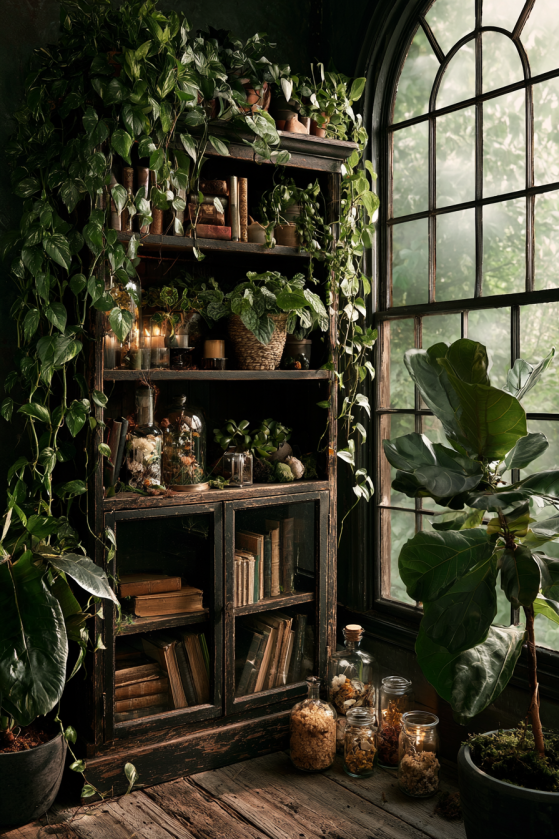
A reading nook that breathes is one with living things in it.
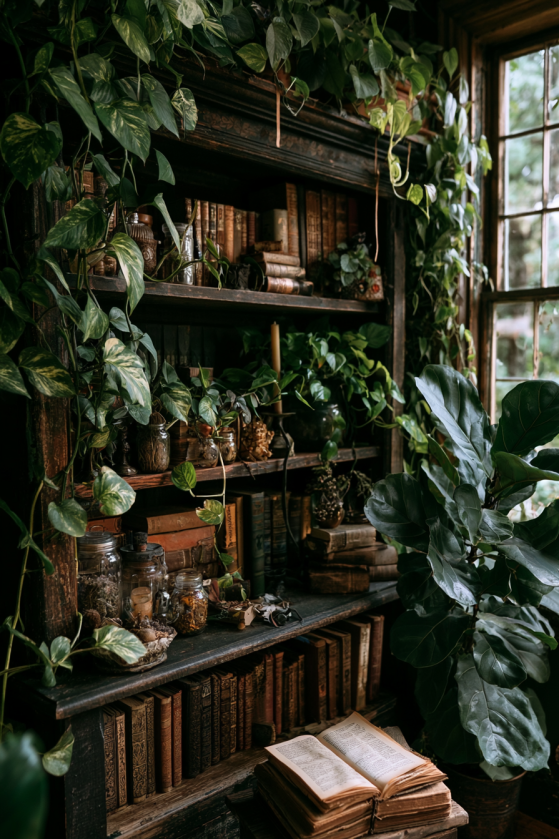
A trailing pothos draped from a high shelf. A dark-leafed fiddle leaf fig in the corner. Dried botanicals in a glass apothecary jar on the lower shelf. A small pot of rosemary or thyme that fills the air with its particular warmth.
Plants complete the space the way nothing else can. They turn a decorated corner into a living room.
The Nook Is Ready. Now Go Read.
You don’t need to do it all at once. Start with the wall color and the chair. Add the shelves. Let the textiles accumulate over time. Let the plants grow.
A good reading nook takes time to become itself. Give it that time.
This post contains affiliate links. If you buy through one of them, I may earn a commission at no extra cost to you. (paid link) As an Amazon Associate I earn from qualifying purchases.
There’s a moment when you step in from the cold — coat damp, boots heavy with mud, the outside world still clinging to you — and the house reaches out and holds you.
In the best mudrooms, it happens before you’ve even taken off your shoes.
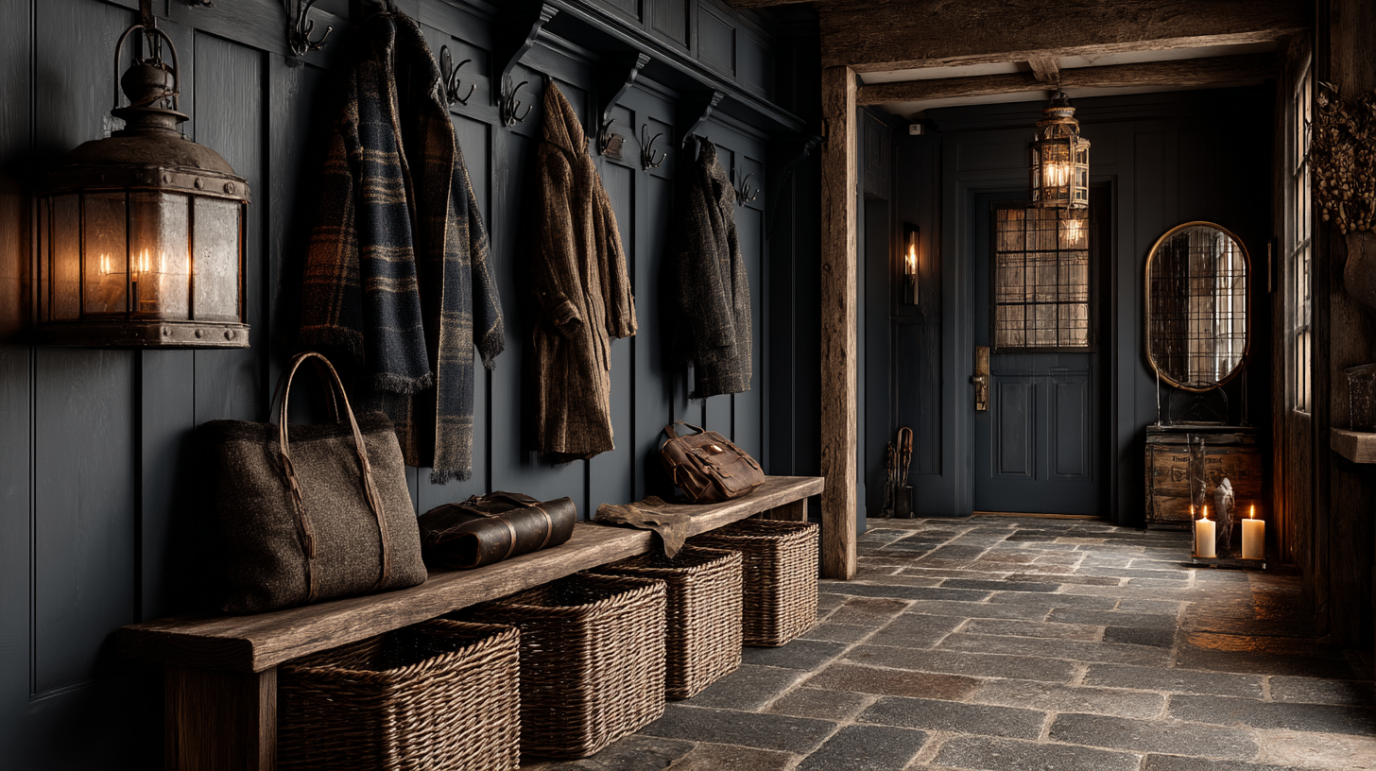
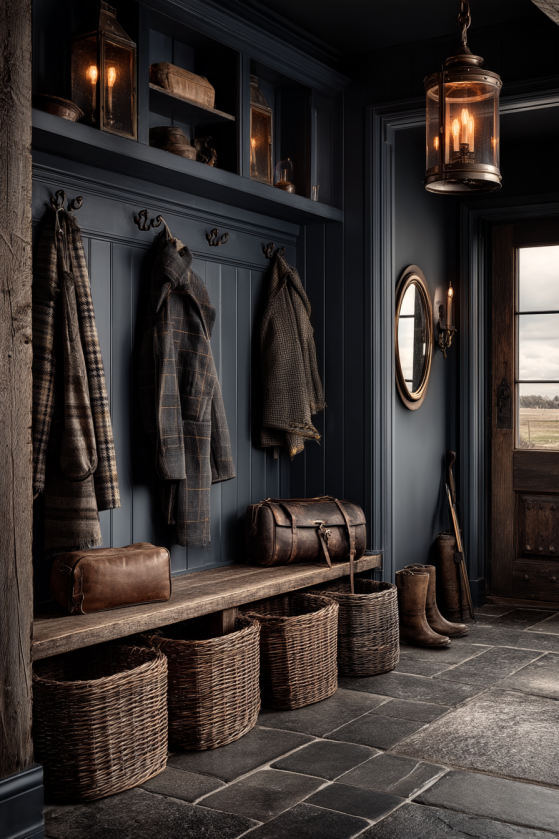
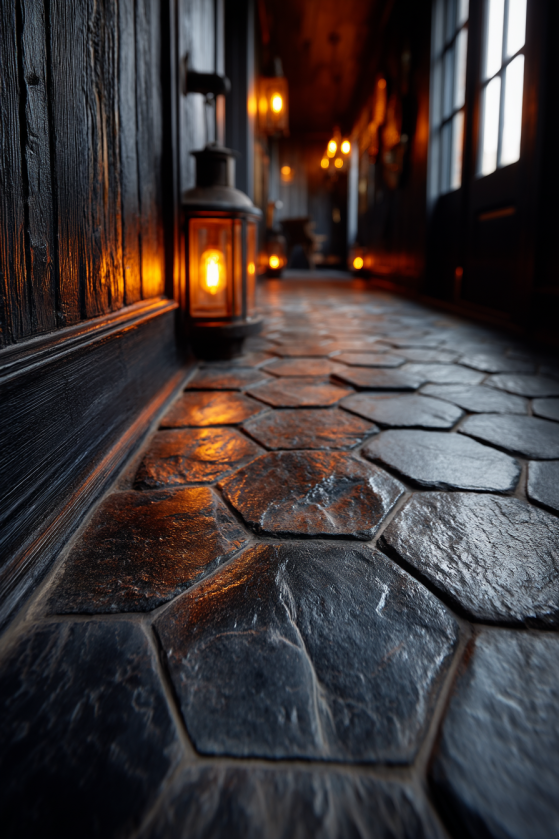
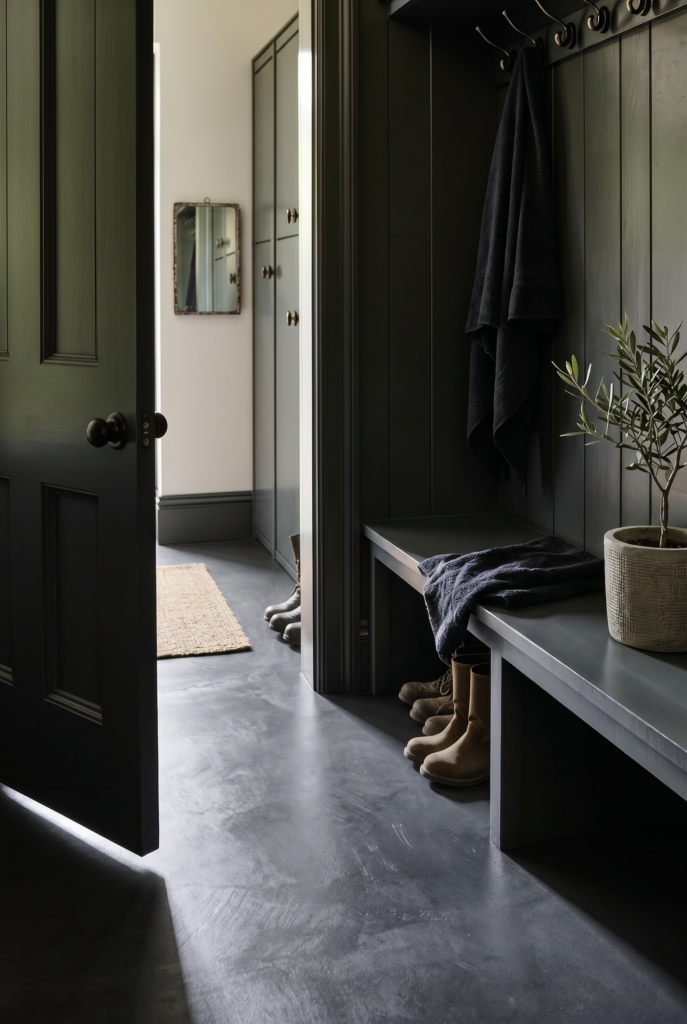
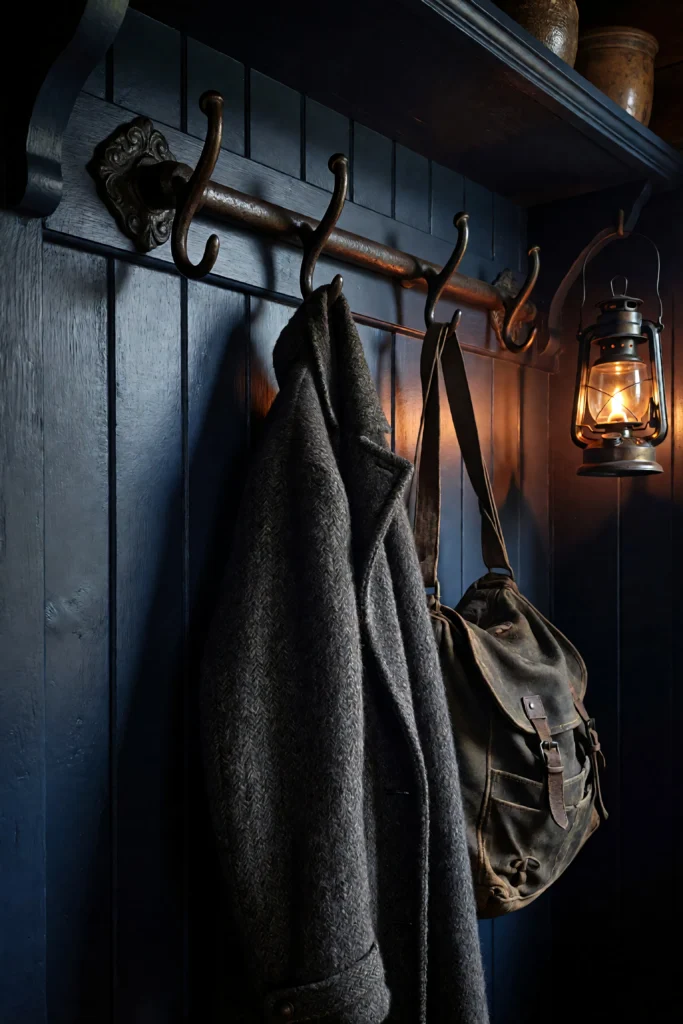
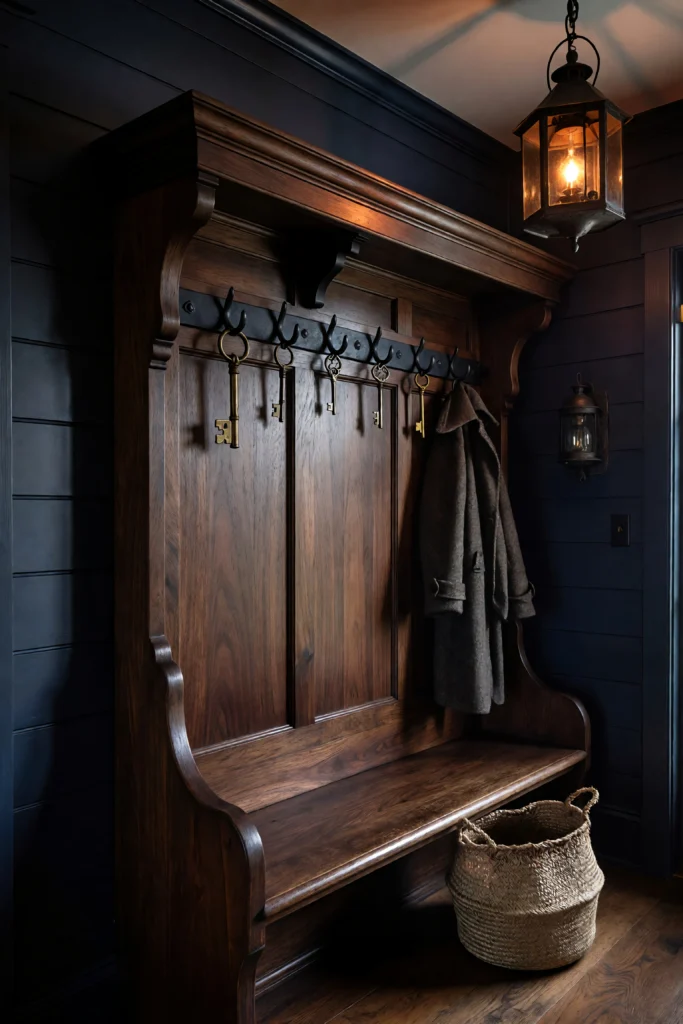
The amber glow of an iron lantern above. The solid thud of a cast iron hook as your coat finds its place. The cool, worn surface of slate underfoot. The faint scent of beeswax and old wood.
This is not a utility corridor. This is a threshold — the first room that says “you’re home.”
And if you’ve been dreaming of a space that feels as dramatic and intentional as every other corner of your house, this guide will show you how a dark farmhouse mudroom can be exactly that.
(This post contains affiliate links — I earn a small commission at no extra cost to you, and I only recommend pieces I would put in my own home.)
What Is the Dark Farmhouse Mudroom?
The dark farmhouse mudroom is what happens when the most hardworking room in your house finally gets treated like a design statement.
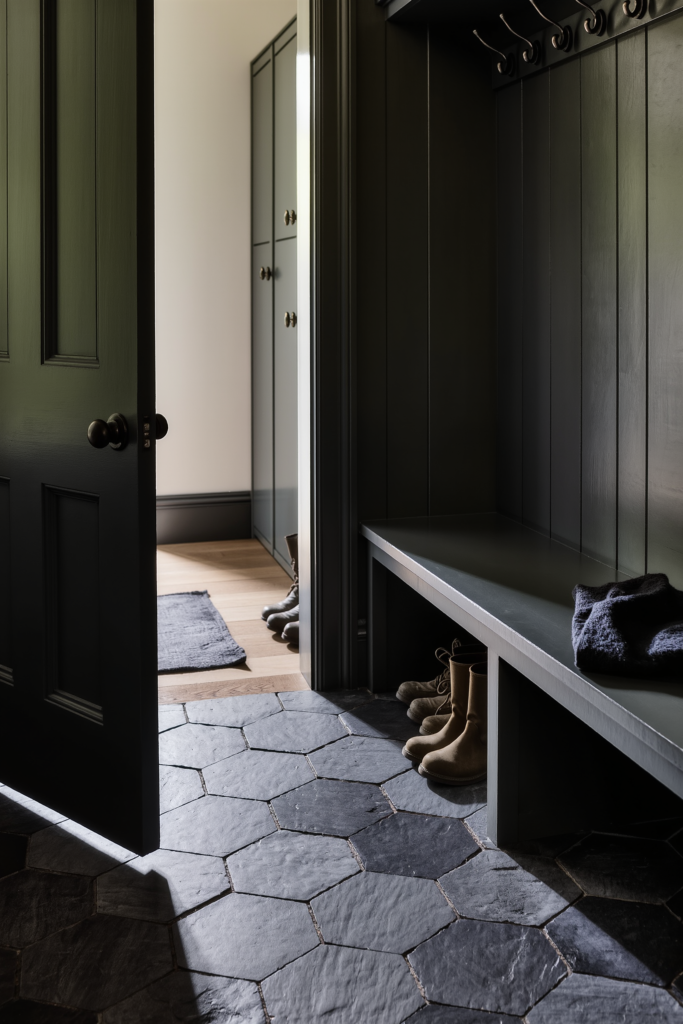
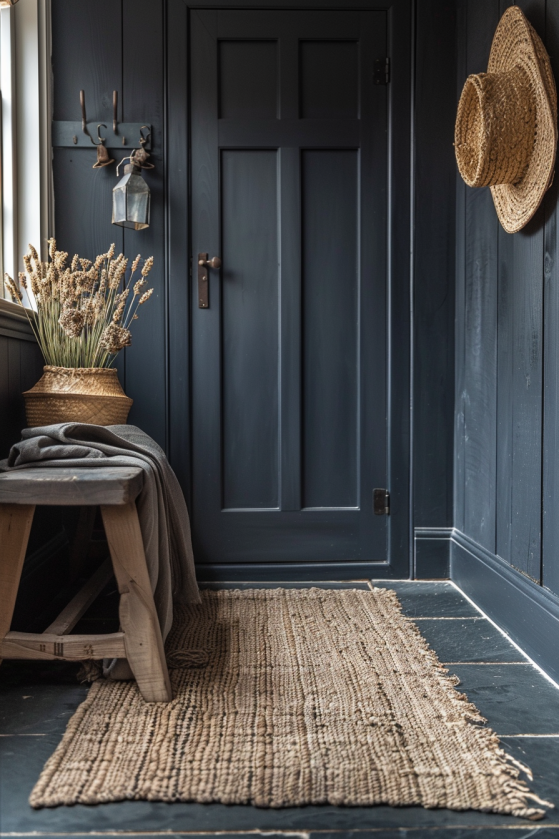
It borrows the bones of classic farmhouse style — shiplap walls, built-in benches, hook rails — and layers in a palette that is deep, moody, and deliberate. Think charcoal paneling. Forest-green painted shiplap. Matte black iron hardware catching the warm glow of a pendant lantern. Worn slate underfoot.
But more than a trend, this is about permission. You are allowed to have a mudroom that feels like a room you actually want to walk into. You are allowed to choose dark paint, iron hooks, and a lantern that casts everything in amber and call it functional design. In the dark farmhouse mudroom, beauty and function are not in conflict. They are the same thing.
The floor is the foundation of the whole aesthetic. Get this right and everything else builds naturally on top of it. Get it wrong — with a bright white tile or a high-gloss finish — and even the most perfectly dark walls will feel disconnected.
Slate Tile
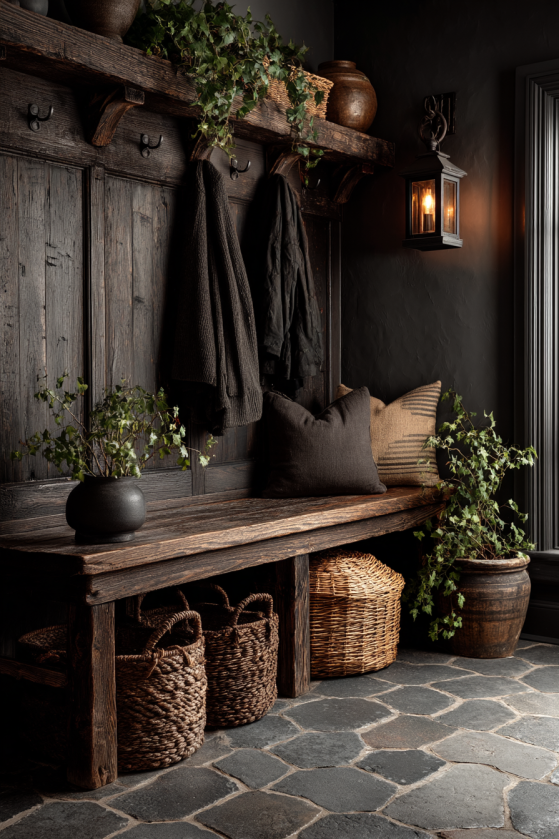
Natural slate is the quintessential dark farmhouse mudroom floor. It is matte, irregular, and carries that beautiful grey-green-black variation that looks like it has always been there. It is supremely practical: slip-resistant, easy to wipe down, and hides mud and grit far better than lighter alternatives. Laying it in a staggered or random pattern adds to that aged, organic quality that no manufactured tile can quite replicate.
If natural slate is outside your budget or project scope, dark ceramic and porcelain tiles that mimic stone are an excellent alternative. Look for matte finishes in charcoal, dark grey, or iron-tone — avoid anything with a sheen. Larger format tiles (12×24 or 18×18) read cleaner and more intentional than small-scale patterns.
Larger format tiles (12×24 or 18×18) will read cleaner and more intentional than small-scale patterns.
Painted Concrete
For mudrooms with existing concrete subfloor, a deep charcoal or forest-green concrete paint or stain is a surprisingly beautiful choice. It is durable, water-resistant, and gives you that industrial-farmhouse crossover quality that layers perfectly with wood and iron elements above.
The walls of your dark farmhouse mudroom are doing two jobs at once: creating the atmosphere and holding everything up. Literally.
Choosing Your Dark – Wall Paint
The most transformative single decision you will make in this space is the wall treatment. Painted shiplap in a deep charcoal, navy, or forest green is the classic choice.
Wrapping the walls of the moody farmhouse mudroom in quiet drama, this deep matte wall paint makes every hook, every boot, and every shadow feel intentional and timeless—turning plain drywall into the perfect backdrop for dark wood and flickering candlelight. Shop This Moody Farmhouse Wall Paint Here (paid link) — simple, enduring, and utterly at home in the dark farmhouse hearth.
One quick note on light: dark walls in a small mudroom will feel intentional and cozy with warm lighting (more on that below). They will feel oppressive with cool overhead fluorescents. The lighting is what makes or breaks the dark wall — commit to both.
Cast Iron Hooks as Statement Objects
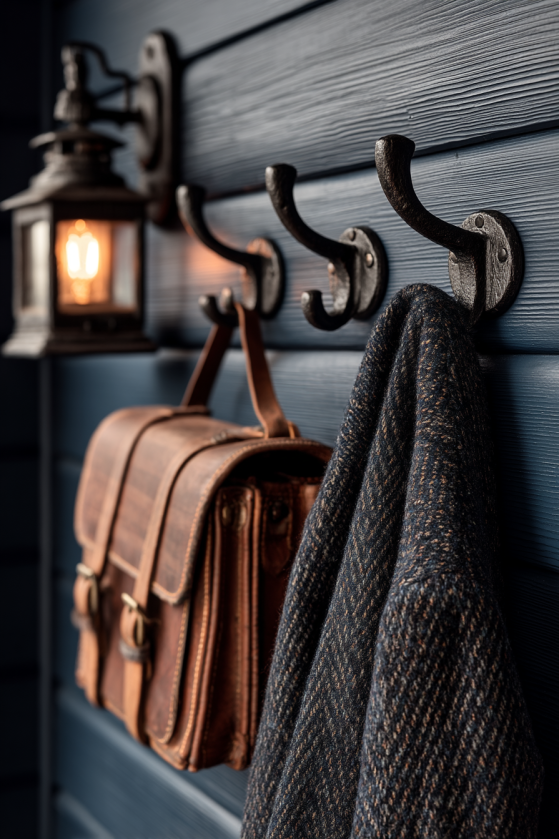
Your hooks are not an afterthought. In a dark farmhouse mudroom, a row of aged cast iron hooks — wrought iron, matte black, or antique brass — running the length of one wall is the room’s visual backbone. They catch the eye. They hold coats and bags with satisfying weight. They have the hand-forged quality that looks as if they were pulled from a century-old farmhouse wall and rehung with complete intention. Cast Iron Wall Mount Hook Strip, Matte Black — Individual Wrought Iron Coat Hooks
Install them at varying heights if you are mixing uses — higher for adult coats, lower for children’s bags and leashes, mid-height for baskets and totes. A single long hook rail is clean and architectural. A clustered arrangement of individual hooks has a more organic, collected quality. Either works. Both are beautiful.
Storage That Looks Deliberate
In most mudrooms, storage is purely functional — it is there to contain chaos. In a dark farmhouse mudroom, storage is part of the composition. Every piece should look chosen.
The Hall Tree or Coat Stand
A Dark-Stained Wood Hall Tree With Seat – , upper hooks, and side storage is the anchor piece of this room. It consolidates everything — hanging space, a place to sit and pull on boots, a shelf or cabinet underneath — into one piece that reads as furniture, not utility shelving. Look for solid wood construction in dark walnut or ebony stain, with iron hardware details that echo the hook rail on the wall.
[AFFILIATE: dark wood hall tree with storage bench and hooks]
The Bench: Where Function Becomes Intention
If you prefer a more built-in or modular approach, a standalone dark storage bench — dark oak, painted black, or reclaimed wood — with a flip-top lid or open cubbies underneath is a natural complement. Pair it with woven baskets or lidded bins in natural materials (jute, seagrass, or dark wicker) for a texture contrast that softens the palette without fighting the mood.
Dark Oak Storage Bench — Tucked beneath the wrought-iron hook rail where muddy boots and wool coats land, this dark oak storage bench becomes the hardworking heart of the moody farmhouse mudroom
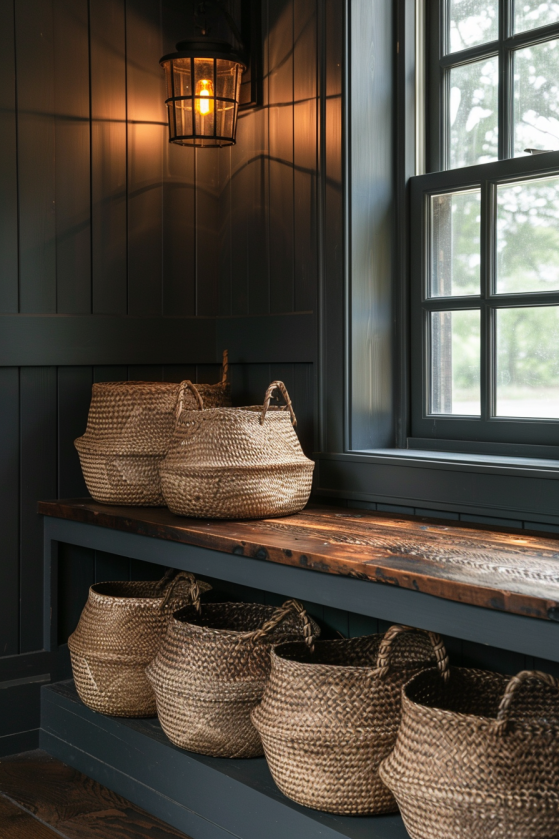
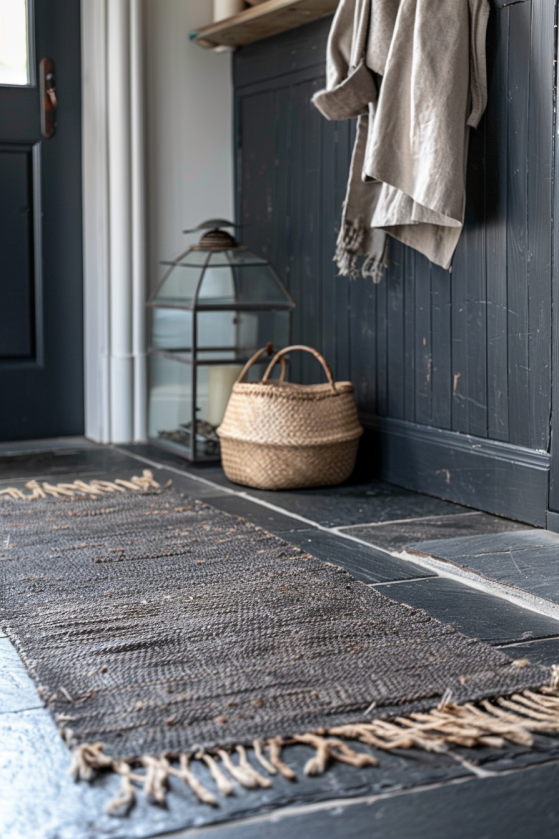
Baskets and Bins – Tucked neatly beneath the dark oak storage bench or lined along the painted concrete floor, these natural jute storage baskets gather muddy boots, wool scarves, dog leashes, and garden gloves without a whisper of clutter.
Never underestimate what a good basket does in a dark space. Woven natural-fiber baskets in tan, oat, or natural create warmth and organic contrast against deep walls. Use them for shoes, hats, gloves, dog leashes, and the general small chaos of daily entry life. Label them with small chalkboard tags for a farmhouse finishing touch that is both practical and charming.
Jute Storage Baskets – High Quality Long Lasting on Etsy Their earthy texture and soft woven warmth bring a touch of the barn and the wild herb garden indoors, keeping the moody farmhouse mudroom calm and quietly beautiful. Shop these natural jute storage baskets here — simple, enduring, and utterly at home in the dark farmhouse hearth.
The Light Source: Why the Lantern Changes Everything
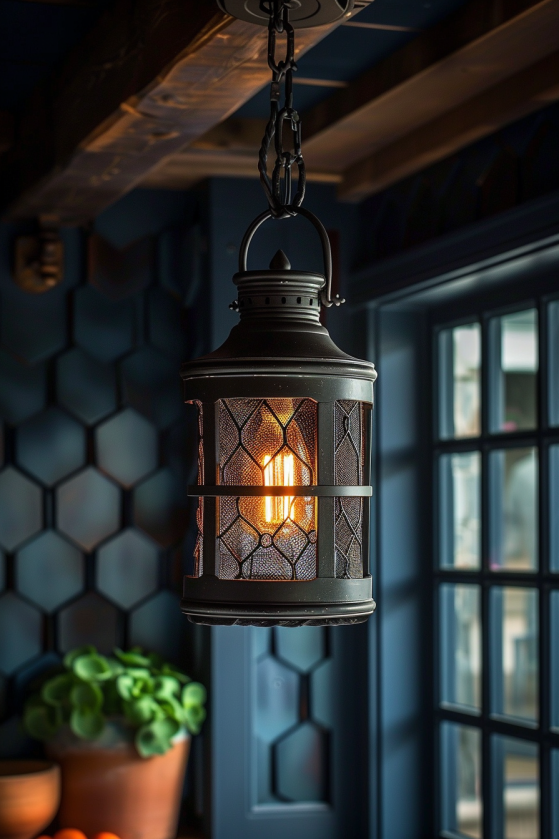
If there is one element that defines the ink-and-lantern quality of this aesthetic, it is the light fixture. Not a recessed can. Not a brushed-nickel flush mount. An aged iron pendant lantern — cage-style, barn-style, or vintage globe — hung low enough to cast a warm, intimate glow over the whole entry.
The warmth of the bulb is everything. Use Edison-style bulbs or warm LED equivalents at 2700K or lower. The goal is amber — the colour of a kerosene lamp, of firelight, of a welcome that reaches out from the ceiling and says the house is glad you came back.
Oil-Rubbed Bronze 12 in Farmhouse Barn Pendant Light (paid link) – Hanging low from the ceiling beams like a relic of old barns and quiet evenings, this aged iron pendant lantern in classic barn or cage style brings blacksmith soul to the moody farmhouse mudroom.
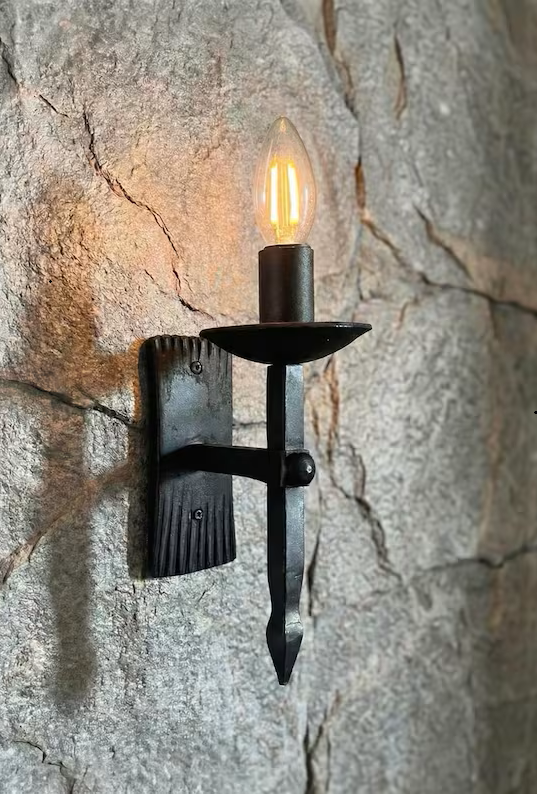
For spaces without a ceiling fixture, or with limited ceiling height, a wrought iron wall sconce on either side of the hook wall gives the same quality of warm, downcast light — and frames the coat hooks in a way that looks quietly theatrical.
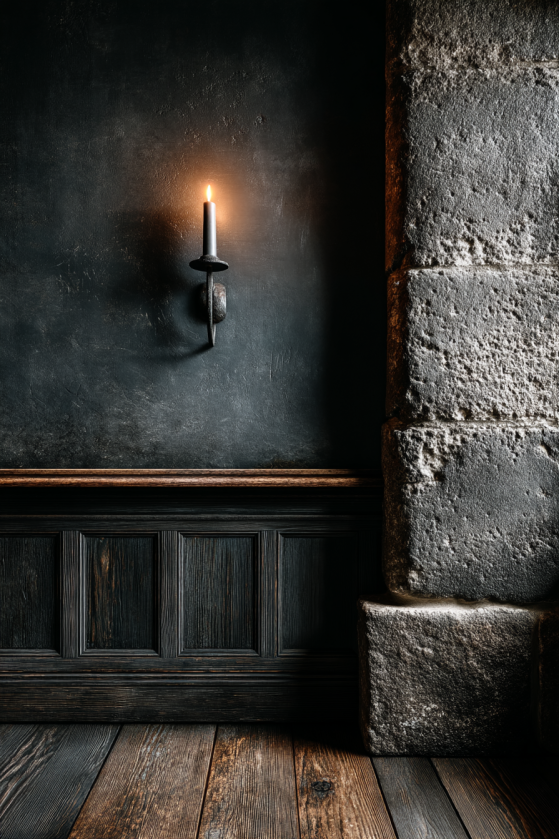
Wrought Iron Wall Sconce, Black Finish – Mounted like silent guardians on the deep charcoal walls of the moody farmhouse mudroom, this wrought iron wall sconce brings raw blacksmith strength and quiet gothic drama. —turning the everyday entry into something ancient and alive simple, enduring, and utterly at home in the dark farmhouse hearth.
Wrought Iron Wall Sconce, Black Finish – Mounted like silent guardians on the deep charcoal walls of the moody farmhouse mudroom, this wrought iron wall sconce brings raw blacksmith strength and quiet gothic drama.
If you have a window in your mudroom, use it. A dark entry with a single source of natural light framed by deep painted walls carries a quality that photographs cannot fully capture. It is the kind of light that makes you pause on your way out.
Seasonal Touches: How to Keep the Mudroom Fresh
The finishing details are what separate a room that looks designed from a room that just looks dark.
Aged Mirror with Dark Frame
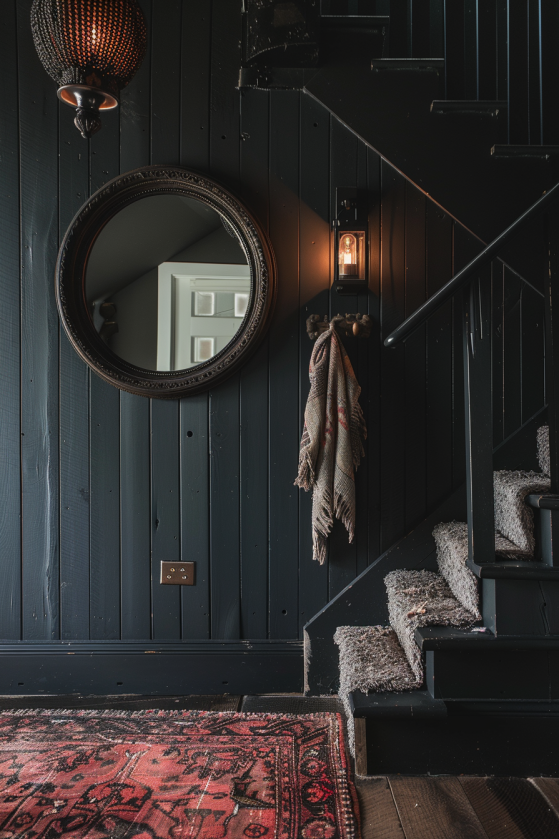
A Large Dark-Framed Mirror — iron, blackened wood, or antiqued — is both functional (your last look before you step out) and expansive. It catches and throws the warm amber lantern light across the charcoal shiplap, doubling the depth and drama of the mudroom in one quiet stroke. The reflection, the shadow play, the raw edge of the frame — this is dark farmhouse at its best. Save this and grab the exact product link in the post.
Dark Metal Umbrella Stand: Standing sentinel beside the dark oak storage bench where rain-soaked boots are shed, this iron umbrella stand brings sturdy blacksmith presence to the moody farmhouse mudroom. Crafted from matte-black wrought iron with clean, timeless lines — simple, enduring, and utterly at home in the dark farmhouse hearth.
Dark Metal Umbrella Stand:Standing sentinel beside the dark oak storage bench where rain-soaked boots are shed, this iron umbrella stand brings sturdy blacksmith presence to the moody farmhouse mudroom.
* **Seasonal styling:** A small dried botanical bundle tucked beside the hooks. A beeswax pillar candle on the bench — unlit, present for scent and form. A spring branch of dark-budded stems in a ceramic vessel. These small additions keep the space feeling alive with the season without requiring a full refresh.
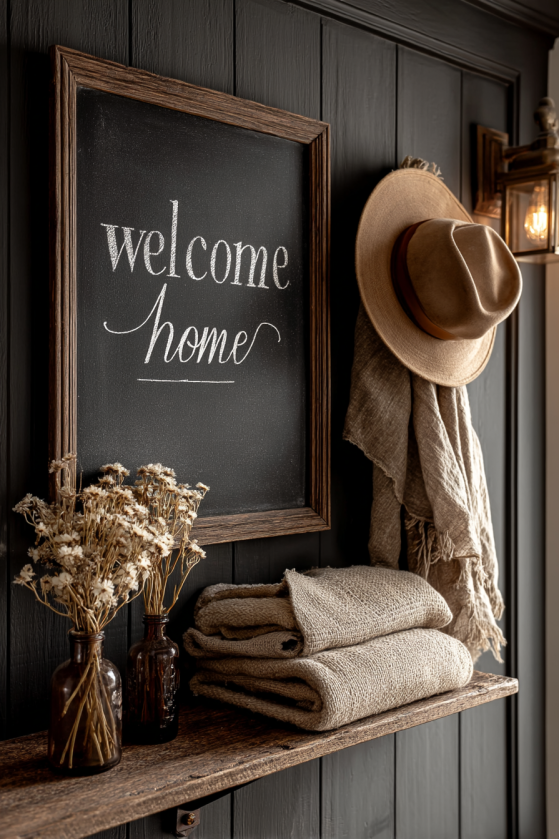
A warm styled mudroom corner — Black Metal Decorative Candle Lanterns, 8.5 in, Set of 2 (paid link)casting amber light over a dark bench with a woven basket, a flat-weave rug in charcoal, a small dried botanical arrangement, and a dark-framed mirror reflecting the hooks behind]
FAQ — Your Dark Mudroom Questions, Answered
“Will it feel claustrophobic?”
Only if you get the lighting wrong. A dark room with warm, well-placed light does not feel small — it feels enveloping, like the house tightening around you in the best possible way. The keys are warm-toned pendant or sconce lighting (never cool overhead fluorescents), a mirror to expand the perceived depth of the space, and, if the room is very narrow, leaving the ceiling in a lighter shade to draw the eye upward. Light is the variable. Get that right and the darkness works with you, not against you.
Better than a white one, honestly. Dark floors and walls hide dirt, mud, and scuff marks far more graciously than their light counterparts. Slate and matte tile do not show grime the way bright grout does. Dark painted walls do not show scuffs the way white beadboard does. Commit to a matte or eggshell paint finish on your walls — satin shows every handprint — and your maintenance burden actually decreases. This is one of the genuinely practical arguments for going dark.
“What if I rent or cannot paint?”
Dark removable wallpaper has come a long way. There are excellent peel-and-stick options in deep charcoals and botanical patterns that photograph beautifully and remove cleanly. Pair them with a freestanding hall tree, portable basket storage, and a swag-hook pendant lantern, and the room transforms fully without a single permanent change. Renters have built extraordinary dark farmhouse mudrooms with nothing but careful furniture choices and removable treatments.
Your Dark Farmhouse Mudroom Starts Here
Your mudroom has always had this potential. The bones were always there — the hooks, the bench, the floor, the door that opens to the outside world and closes again with a satisfying weight. All it was missing was intention. A colour that says *this is a room I chose.* A lantern that says *you are welcome here.* A cast iron hook that says *leave the world outside and come in.*
The dark farmhouse mudroom is not a trend you are chasing. It is a truth about what a threshold can be — functional, atmospheric, and entirely yours.
**Save this post to your mudroom Pinterest board** and explore more dark farmhouse inspiration across @DarkHomestead.
This post contains affiliate links. If you buy through one of them, I may earn a commission at no extra cost to you. (paid link) As an Amazon Associate I earn from qualifying purchases.
Close your eyes for a moment.
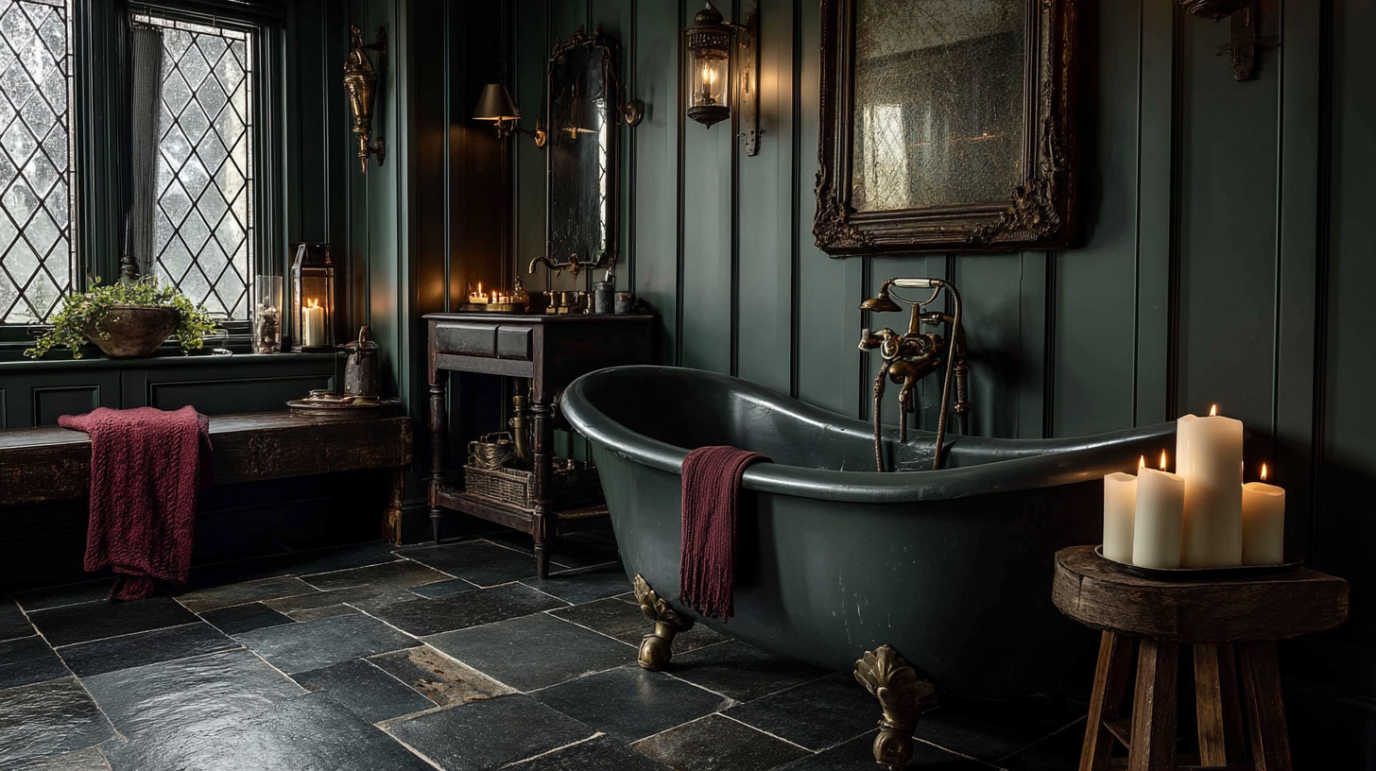
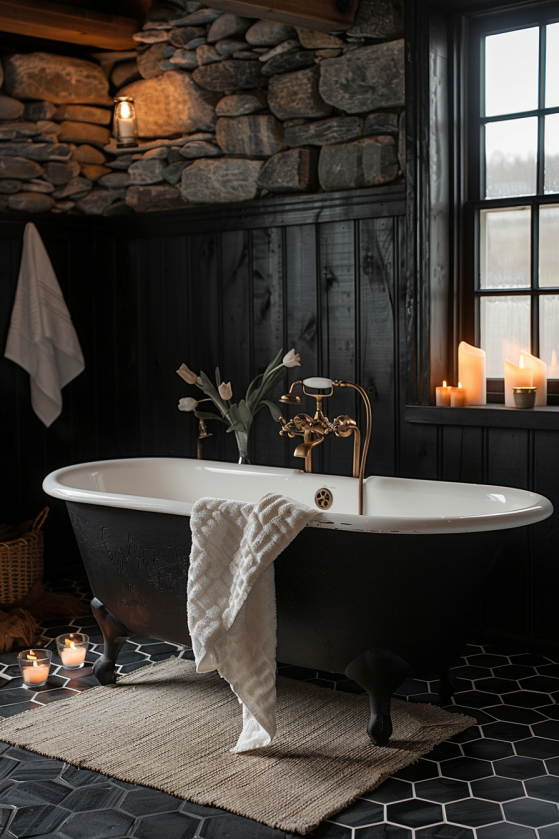
You are standing in a bathroom that smells of cedar soap and warm water. Rain taps quietly at the old glass window. The walls are deep — so dark they seem to breathe — and in the center of the room, lit by the warm orange glow of brass sconces, sits a cast-iron clawfoot bathtub.
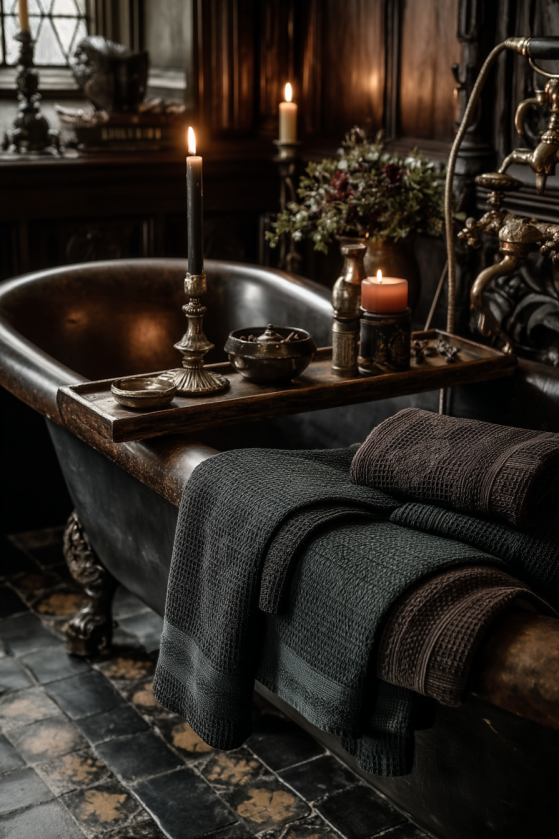
The enamel catches the light like a winter evening sky. The faucet is aged brass, slightly tarnished at the edges, and a single bead of water hangs before it falls. A heavy linen towel in deep forest green rests on a wooden stool. There is a candle. There is quiet.
This post contains affiliate links. If you buy through one of them, I may earn a commission at no extra cost to you. (paid link) As an Amazon Associate I earn from qualifying purchases.
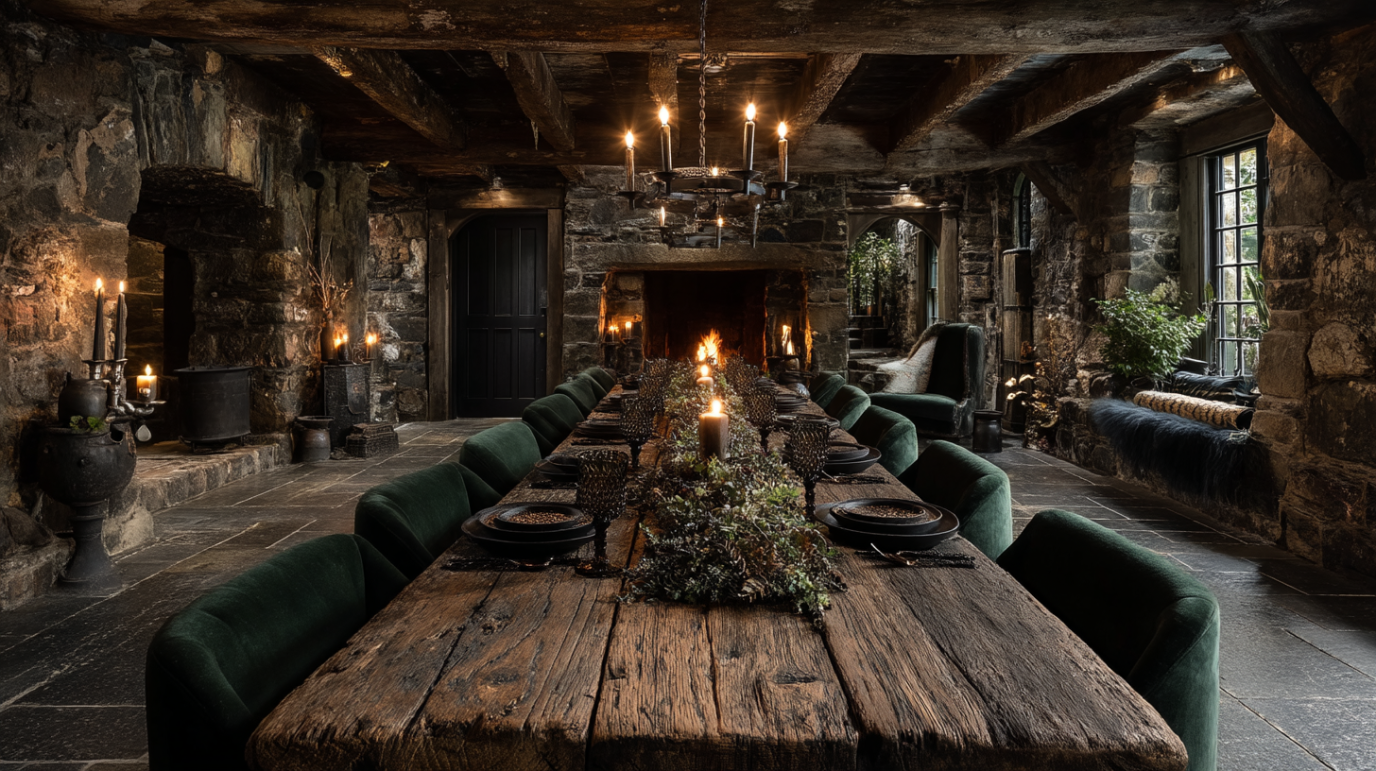
There is a moment — just after the candles are lit, just before the first guest arrives — when a dining room becomes something more than furniture and four walls.
The light pools amber on dark oak. A single taper flickers against the grain of the wood. The smell of beeswax and woodsmoke drifts through the air, and somewhere across the table, crystal catches the flame and throws a slow arc of light across a stone wall.
This is the room your guests will remember long after the meal ends.
This post contains affiliate links. If you purchase through links on this page, I may earn a small commission at no extra cost to you.
What Is the Dark Farmhouse Dining Room Trend — And Why Is Everyone Doing It?
For years, the dining room was the most overlooked space in the house. It received the leftover furniture, the safe neutral paint, the uninspired pendant light picked off a clearance shelf. It was the room families walked through to reach the kitchen, not the room they lingered in.
Then, something shifted.
Homes & Gardens declared dark, dramatic dining rooms one of the defining interior directions of the year. Decorilla reported that deep-toned, material-rich dining spaces were among their most-requested client briefs. LivingEtc named it the “anti-beige dining room movement.” And on Pinterest, searches for “dark farmhouse dining room” and “dark moody farmhouse dining room ideas” climbed steadily throughout the year.
The dining room — finally — was being taken seriously again.
The dark farmhouse dining room sits at the intersection of rustic texture and dramatic atmosphere. It draws on the materials of working land: reclaimed oak, wrought iron, rough stone, dark linen, and beeswax dried into old grain. It is not cold or theatrical for its own sake. It is warm and structural and deeply human — a room designed not just for eating, but for the ritual of gathering around a table and marking time with people you love.
If you have been saving these rooms on Pinterest for two years while telling yourself it would look “too gothic farmhouse” or “too dark for guests” — read on. This post is your permission.
LAYER YOUR OWN DARK FARMHOUSE DINING ROOM (Trend Section)
The Table — Anchor of Your Dark Farmhouse Dining Room
Every great dining room begins with the table. In the dark farmhouse aesthetic, the table is not merely furniture — it is the structure around which everything else is organized. Get this right, and the rest of the room builds itself.
What to Look For
Scale matters more here than in almost any other room. The dark farmhouse dining table should feel substantial — thick legs, a wide apron, and a top with visible grain or honest texture. Reclaimed oak, solid walnut, or ebony-stained pine in a trestle or farmhouse-leg silhouette are the materials of the moment. You want something that looks like it has hosted harvests, not just dinner parties
A Note on Scale
A dark-finished farm table with a heavy trestle base is the ideal starting point. For smaller rooms, an extendable dark wood table gives you permanence and presence without sacrificing flexibility for daily life.
If your room is small, resist the urge to downsize the table. A single large, heavy table anchors the room — it reads as confident, not crowded. Add benches along one or two sides instead of chairs all around. This opens sightlines while reinforcing the farmhouse character. Scale is the first thing that signals intention in this aesthetic.
Once the table is decided, the chairs are where personality lives. In the dark farmhouse dining room, the most interesting chair arrangements are intentionally mismatched — mixing materials in a way that feels collected, not coordinated.
Colors That Work
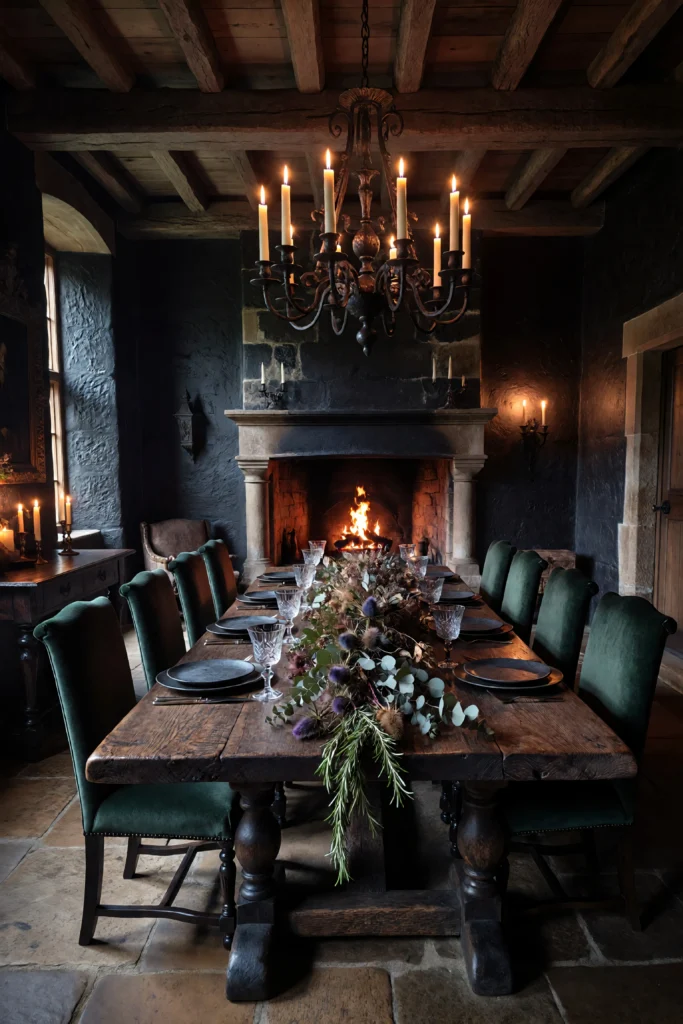
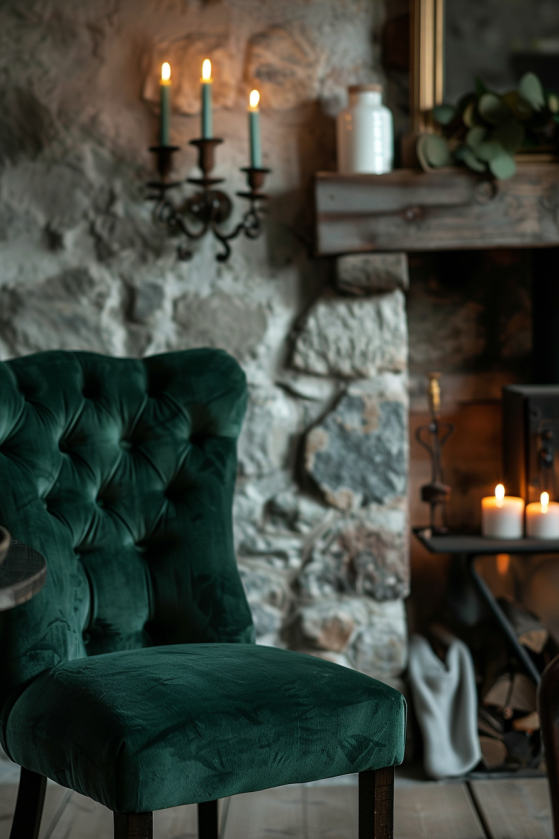
Forest green — earthy, botanical, pairs beautifully with dark oak and candlelight
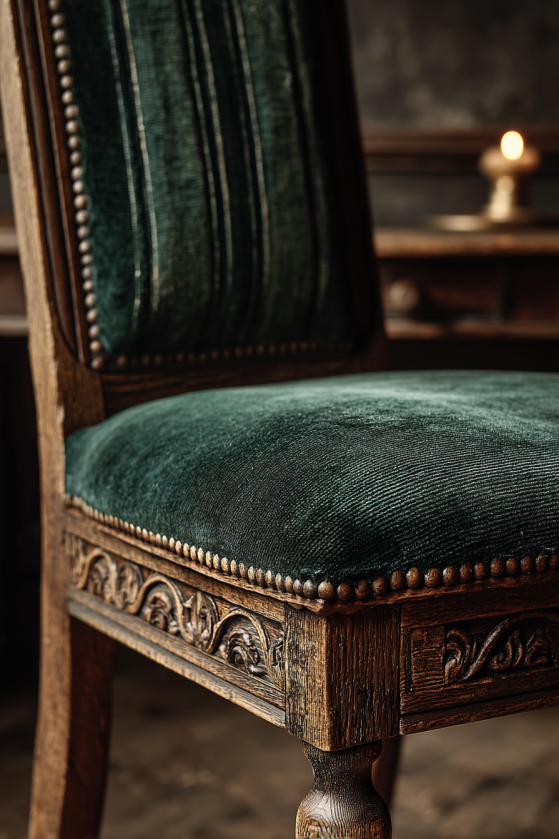
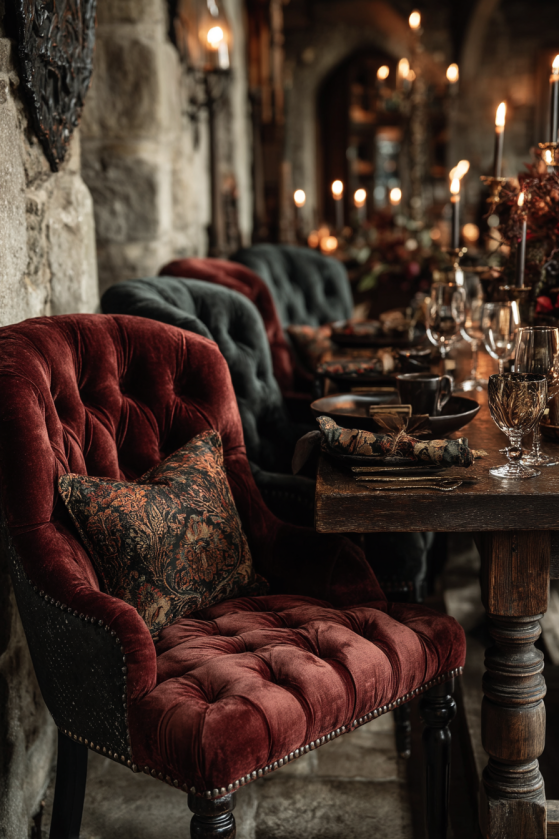
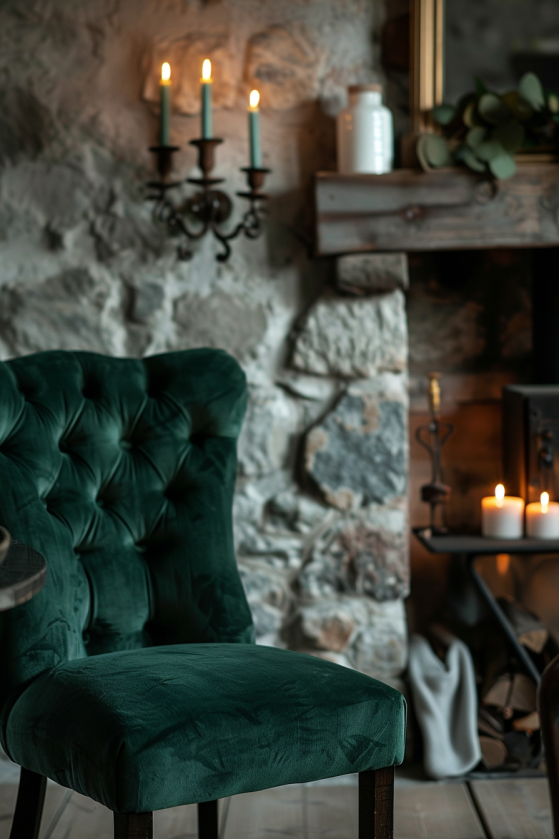
Consider pairing velvet dining chairs at the head and foot of the table with iron-backed or raw wood-framed bench seating along the sides. The velvet delivers richness and warmth. The harder material keeps it grounded and honest to the farmhouse character. Velvet Dining Chairs (paid link)
Avoid chrome legs or high-gloss synthetic fabric. The goal is tactile richness, not polish.
Light and Shadow — Chandeliers, Candles, and Sconces
Lighting is the single most transformative element in the dark farmhouse dining room. Get it wrong and you have a gloomy, flat space. Get it right and you have a room that feels like firelight and old stone and centuries of good meals.
The Statement Chandelier
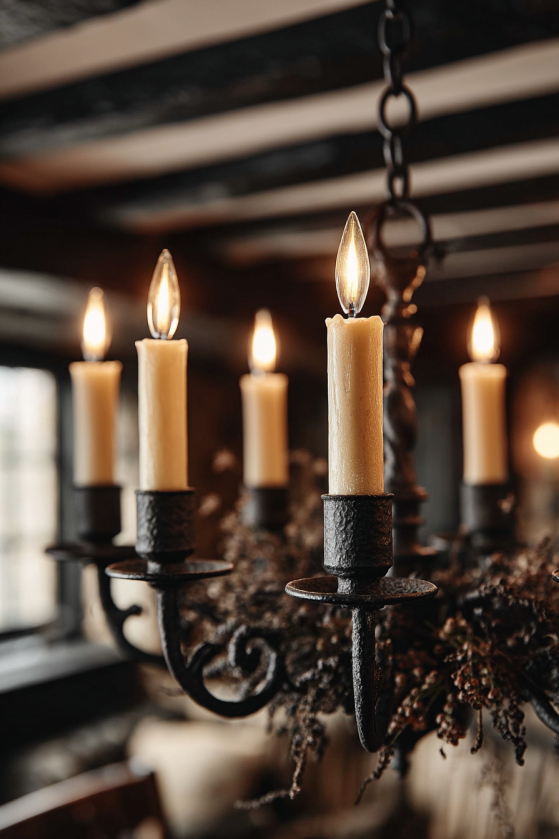
The chandelier is your architectural moment. For this aesthetic: iron or aged brass, candelabra-style or flame-tip bulbs, substantial visual weight, organic detail — twisted iron arms, aged patina, rough-forged texture.
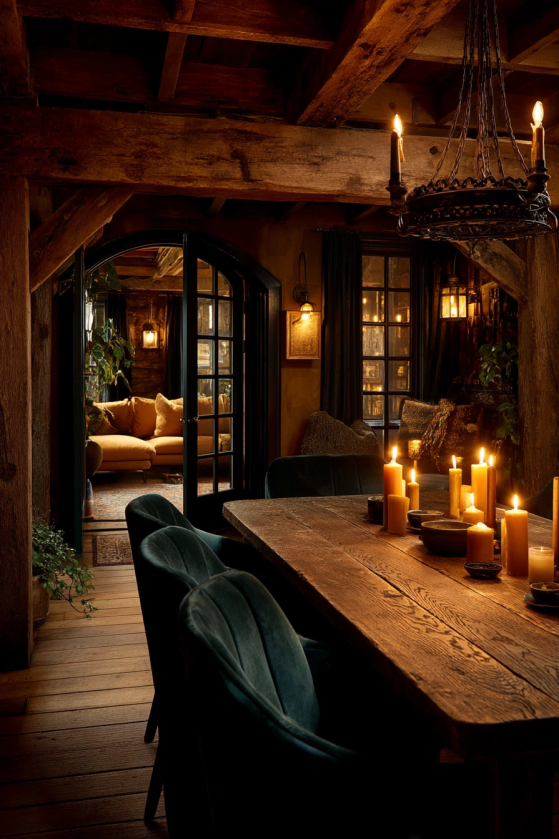
There’s a quiet romance that settles over a moody farmhouse when candles are lit. Their flickering flames cast a warm, golden light that dances across reclaimed wood beams and soft, rumpled linens, softening every edge and deepening every shadow. In that gentle glow, the space feels intimate and alive—like a tender embrace between rustic simplicity and quiet sensuality.
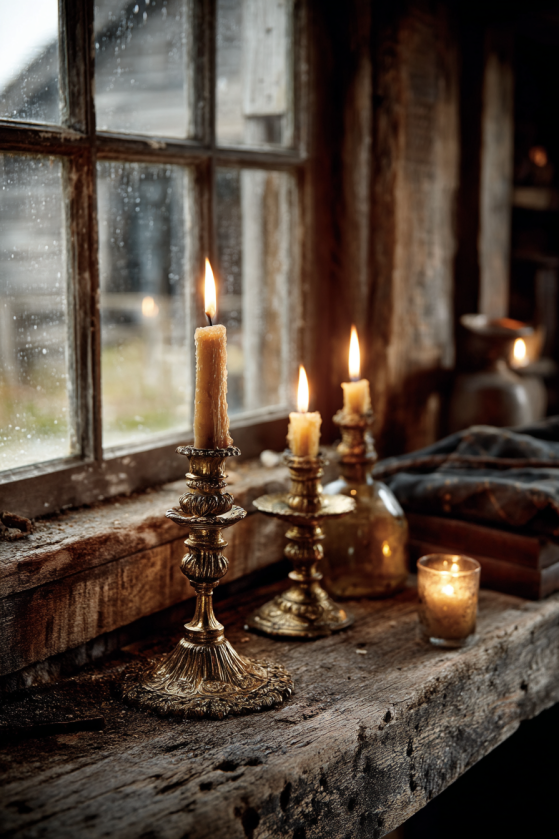
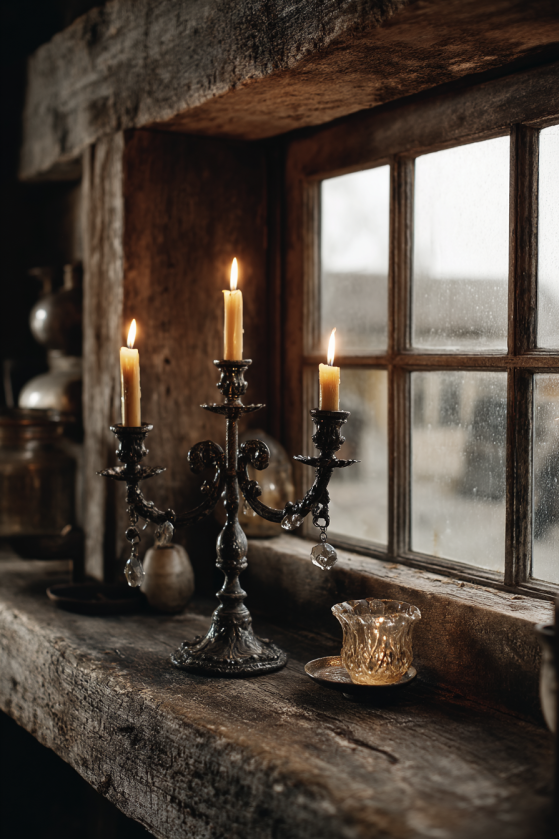
In this room, candles are not decoration. They are infrastructure. on the table and iron wall sconces on flanking walls give you layered, organic light that no overhead fixture can reproduce. Use beeswax tapers — they burn longer, smell cleaner, and carry honest quality that fits the dark farmhouse rustic aesthetic exactly. Black Iron 5-Arm Candelabra (paid link) or Etsy for More Artistic Unique Styles
Formed in cast iron, this three-arm candelabra is structured around a central column with two lateral arms and a raised center holder.
The surface carries a dark, textured finish with subtle irregularities from casting and finishing.
Install a dimmer switch on every light source in your dining room. It is the cheapest single upgrade that most profoundly changes how a room feels.
Walls and Windows — How to Darken a Room Without Closing It In
Dark walls are the most common anxiety point for homeowners considering this aesthetic. “Won’t it make the room feel small?” Only if you do nothing else. Dark walls paired with candlelight, warm-toned wood, and reflective surfaces like crystal glassware and aged brass create depth, not compression.
Paint or Wallpaper
Wallpaper:Jewel-Tone or Dark Textured Wallpaper (paid link) with a forest, stone, or linen motif brings extraordinary character without requiring the confidence of all-over dark paint. A single papered wall reads as deliberate and sophisticated.
Paint In The Perfect Shades (paid link): Deep forest green, charcoal, deep navy, or a warm near-black. If nervous, begin with a single feature wall — the wall your table sits against, or the wall anchoring your sideboard.
Windows and Curtains
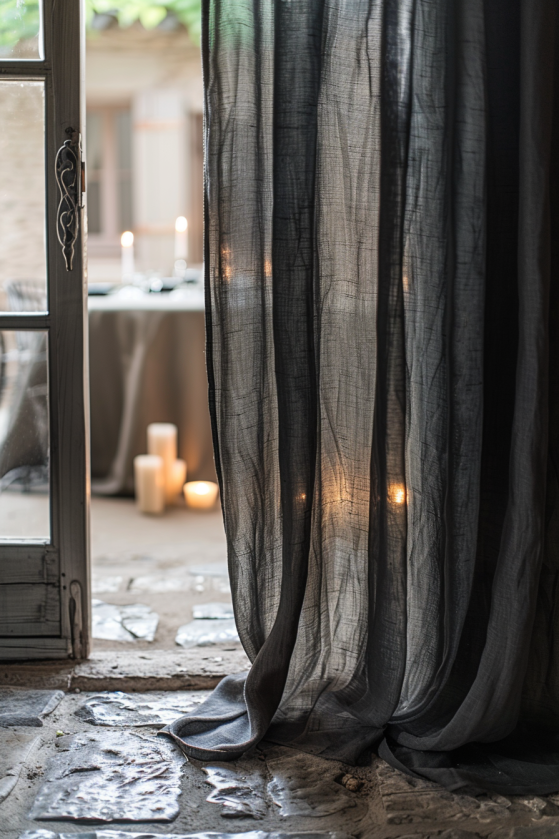
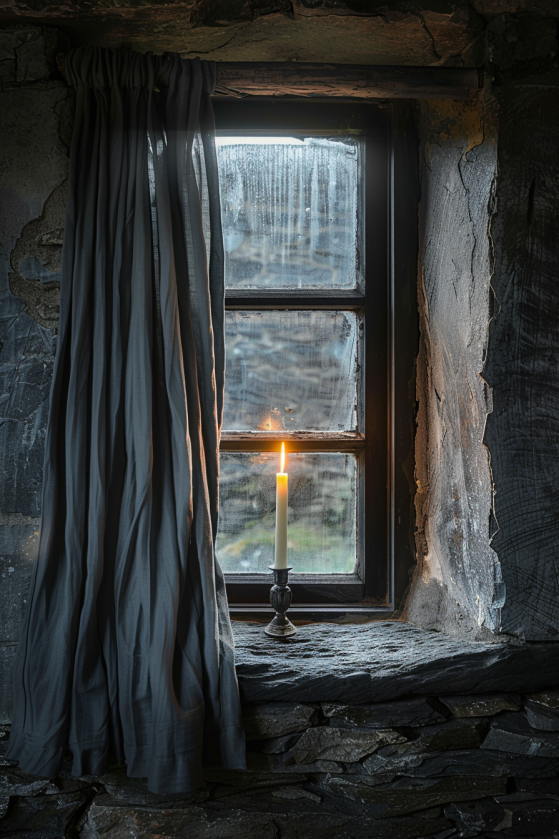
Floor-length curtains in heavy fabric are essential. In charcoal linen, deep velvet, or blackout fabric, they frame the room and transform the window into a deliberate architectural feature. Pool them slightly on the floor. Keep hardware in matte black or aged brass to match the room’s metalwork. Dark Linen Curtains Farmhouse Style
Styling the Table and Sideboard — The Finishing Layer
Table and sideboard styling is what separates a dark farmhouse dining room that feels finished from one that feels like a renovation in perpetual progress.
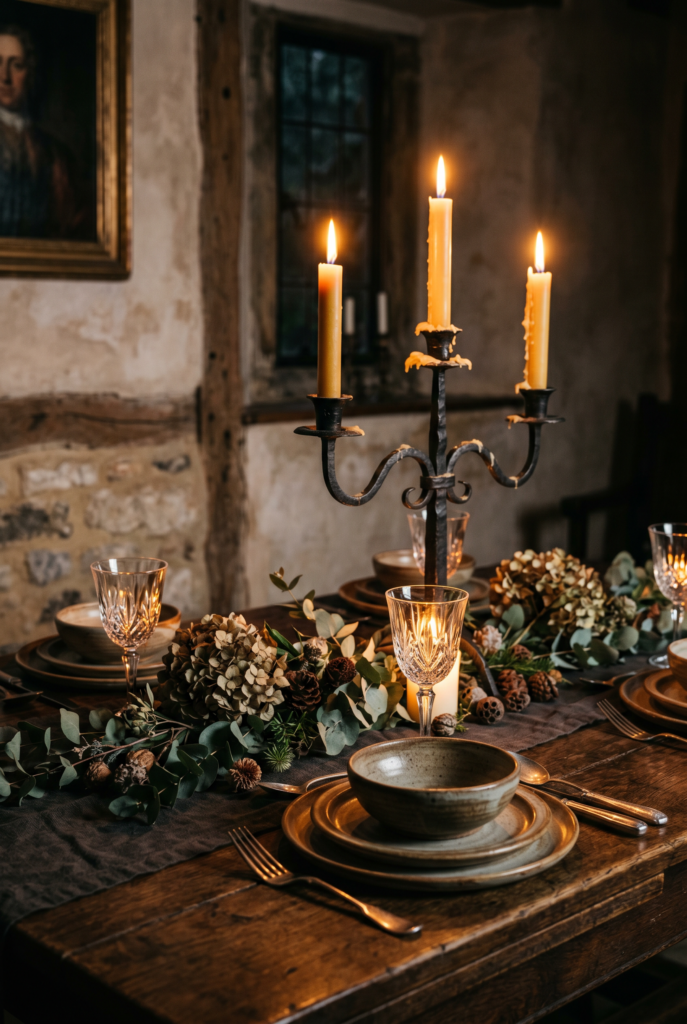
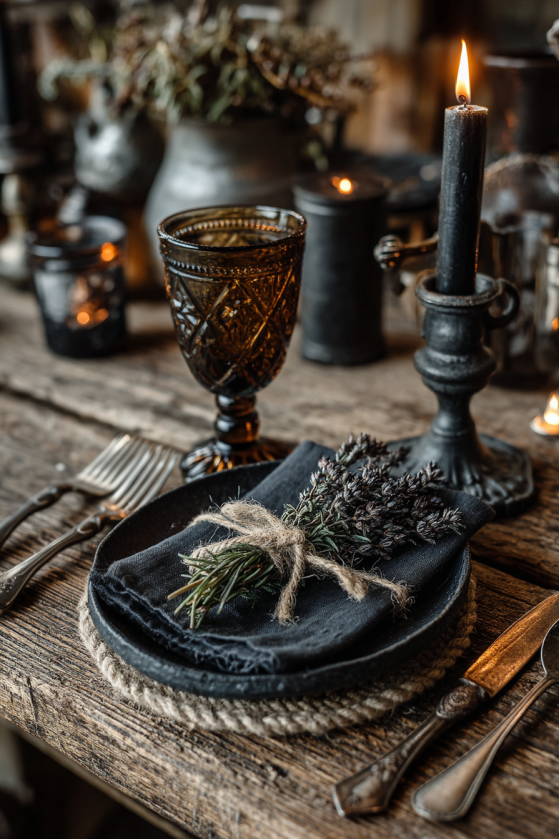
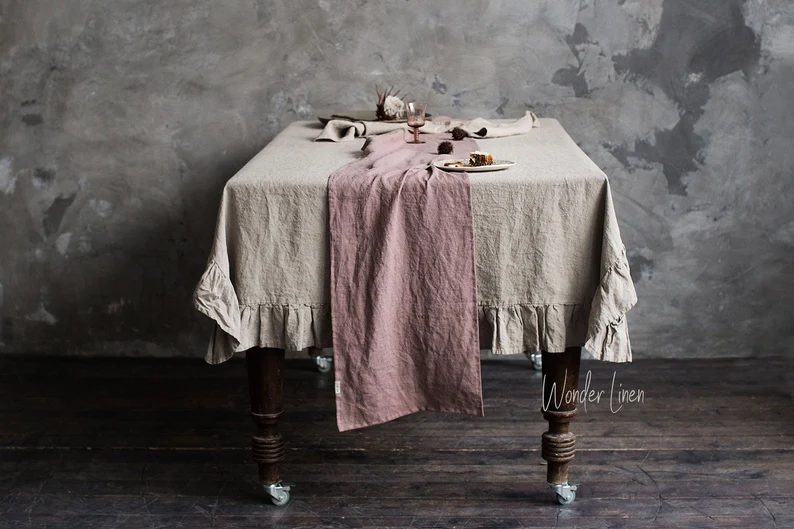
A dark linen table runner grounds the place settings without covering the wood entirely — that grain should be visible. Set dark ceramic or matte stoneware dinnerware at each place. Aged Flatware In So Many Optionscatches candlelight with warmth that polished silver does not.
The Table
Best Seller On Etsy : Dark Colors Available – This table runner in pure linen will look great on your table year round. The durable yet elegant fabric will go great with any meal and occasion.
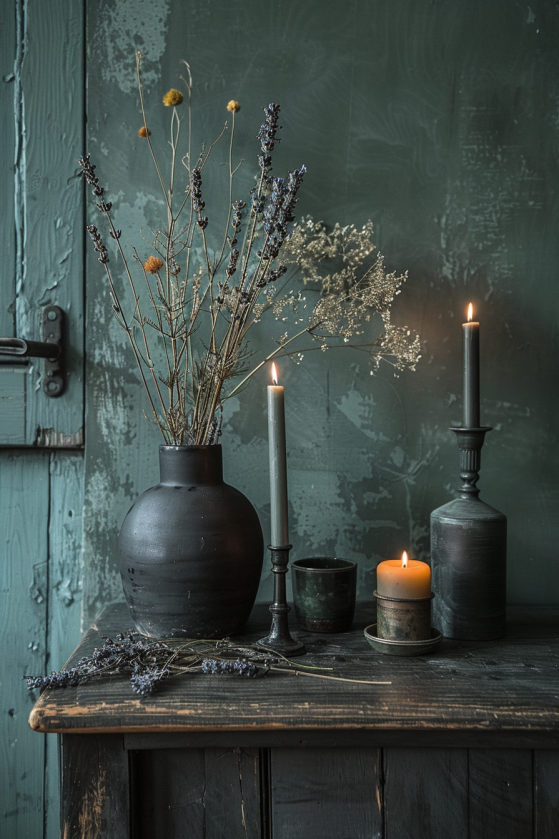
Dried botanicals — eucalyptus, dried pampas, seed pods — in a dark ceramic vessel or twisted iron container add organic texture. Keep arrangements asymmetrical. This room does not do symmetry.
The Sideboard
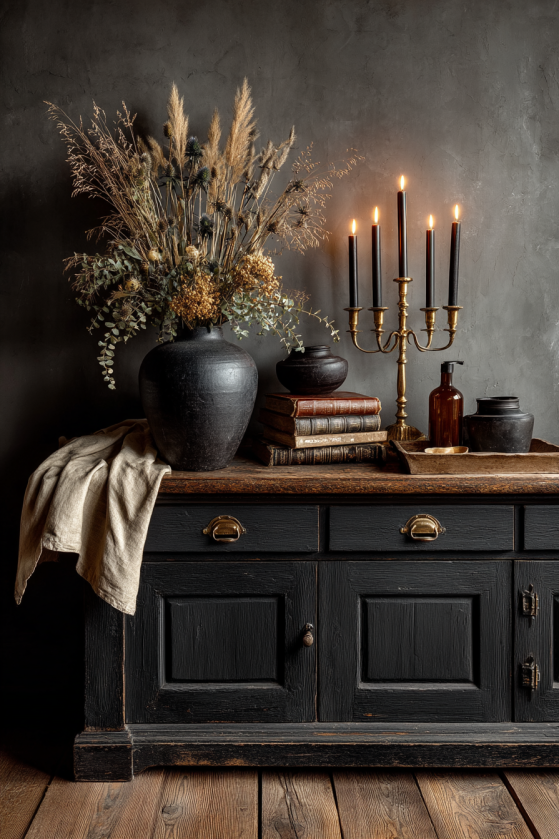
An iron or dark wood sideboard performs double duty: practical storage and primary styling surface. Keep the top restrained: varying-height taper candles in iron holders, a ceramic vase with dried grasses, a stack of dark linen napkins. Do not crowd it.
Dark Wood Sideboard Buffet – Rustic Farmhouse Style (paid link) – Tucked against the shadowed wall like a quiet heirloom, the classic style sideboard carries the soul of an old farmhouse kitchen. Sturdy yet graceful, it turns everyday storage into a story of gathered harvests and slow mornings—simple, enduring, and utterly at home in the cottagegoth hearth.
Addressing Common Concerns — The Honest FAQ
“Will guests find it depressing?”
The opposite tends to be true. Candlelit, dark dining rooms are consistently described as “the coziest” and “best dinner I’ve attended.” The association of dark interiors with gloom comes from overhead fluorescent lighting in poorly lit spaces — not from this aesthetic itself. Firelight and candlelight in a deep-toned room with warm wood is intimate and inviting.
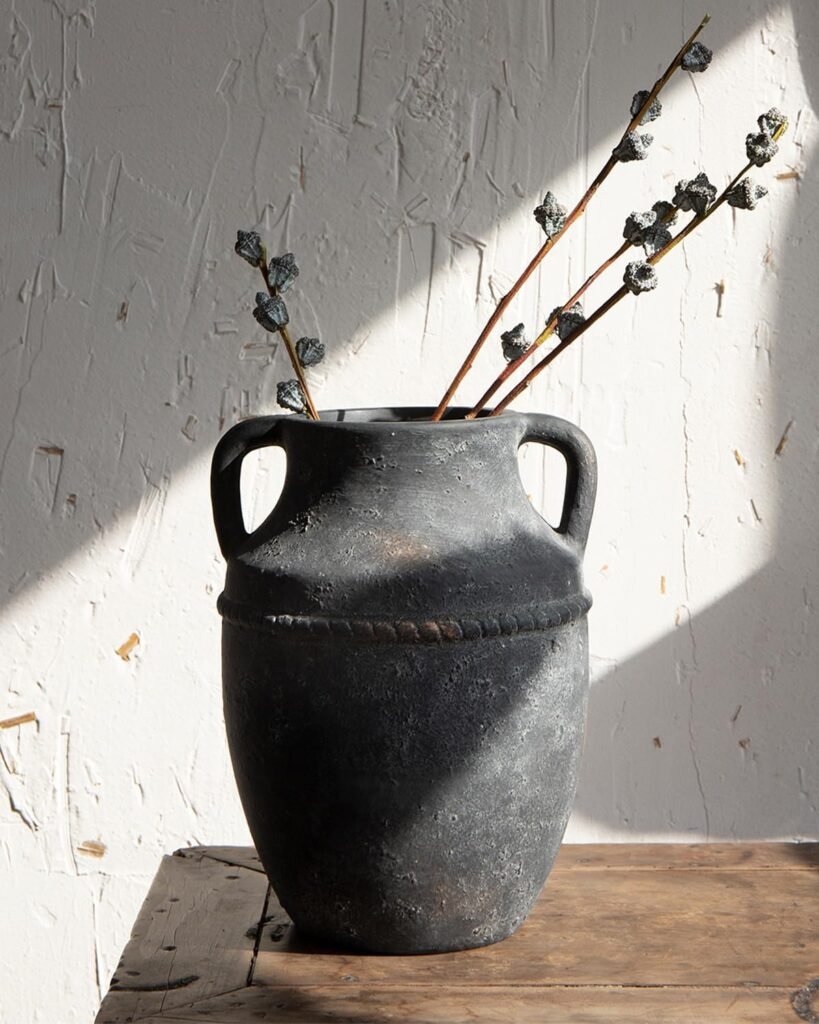
Ceramic Flower Vase Home Decor – Farmhouse Rustic Vases Pottery Barn – Vintage Terracotta.. Handcrafted from Real Clay – Crafted from natural clay, this farmhouse vase preserves the authentic texture and warmth of the material.. Farmhouse Terracotta Pottery Vase (paid link)
“Is dark wall paint a mistake if I ever want to sell?”
Paint is the cheapest thing in the house to change. Do not make permanent decisions based on a hypothetical future buyer. Design for the life you are living now. Dramatic, well-photographed dining rooms consistently perform well in real estate listings.
“My dining room gets almost no natural light. Is this a terrible idea?”
Rooms with limited natural light are actually ideal candidates for this aesthetic. Design for candlelit evening meals. Let the lack of natural light be an asset, not a liability.
Budget vs. Investment: Building Your Dark Farmhouse Dining Room
Not every piece in a room like this needs to cost a fortune. The art of building something that feels genuinely old, genuinely heavy, and genuinely there is knowing where to spend and where to save — and making both choices with intention.
The Table
A reclaimed oak or solid-wood trestle table is the one piece worth stretching your budget for. It is the room’s spine. A well-built farmhouse table in real wood will only deepen in character over time — the grain darkens, the surface takes on patina, and it begins to look like it has always been there. If you can only invest in one thing, let it be the table.
Velvet Dining Chairs
Velvet dining chairs are more forgiving. Mid-range options in charcoal, near-black, or forest green can look genuinely rich when the silhouette is right — look for structured backs, solid wood or metal legs, and dense pile. Investment pieces in linen-velvet blends or hand-tufted finishes will hold their shape over years of use, but beautiful mid-range chairs are plentiful.
Lighting
The chandelier is worth spending on — genuine wrought iron or hand-forged metal carries a physical weight and texture that lighter reproductions cannot replicate under candlelight. Buy the best chandelier you can and let it anchor everything below it.
Note: Dark Linen Curtains Floor-to-ceiling linen curtains are non-negotiable in a dark farmhouse dining room. Hang them high, let them pool softly on the floor, and choose deep charcoal, forest green, or a muted natural stripe. The heavy, breathable linen absorbs harsh daylight, muffles sound, and turns ordinary windows into something quietly dramatic. In candlelight, the fabric catches a soft, lived-in glow that makes the whole room feel warmer and more intimate.
Iron candelabras, taper holders, and wall sconces are one of the easiest places to save. Cast iron and powder-coated finishes at accessible prices can be indistinguishable from far more expensive versions
Textiles & Table Setting
Floor-to-ceiling curtains deserve investment (or patience). Dark linen or velvet needs real weight and drape. The dark linen table runner, however, is an easy save — texture and colour are all that matter here.
Dinnerware, Flatware & Storage
Matte stoneware dinnerware and aged brass or matte black flatware are quiet wins — the visual result is nearly identical to pieces costing several times more.
For storage, a sideboard or iron-framed cabinet is worth patience rather than price. Secondhand, estate sale, or antique market pieces will almost always outperform budget new options in character and construction.
Dried Botanicals & Small Objects
Dried botanicals, ceramic vessels, and seed pod arrangements are an easy save — foraged, sourced simply, or found in quiet corners of the internet, they photograph beautifully and cost very little.
LAYER YOUR OWN DARK FARMHOUSE DINING ROOM (Budget vs Investment)
The table, the chandelier, and the wall color will do 80% of the work. Everything else deepens and refines over time.
If there is one thing to take from this room, let it be permission. Permission to commit to the dining room you have been saving on Pinterest. The dark farmhouse dining room is not a trend that will date quickly — it is a return to something older and more honest than beige walls and a drum shade pendant light. It is the dinner table as it was always meant to be: lit by fire, anchored in solid wood, set for a proper feast.
Save this post to your @DarkHomestead board on Pinterest. Explore more dark farmhouse dining room ideas. And when you are ready to shop the look — every affiliate pick above was chosen with exactly your room in mind.